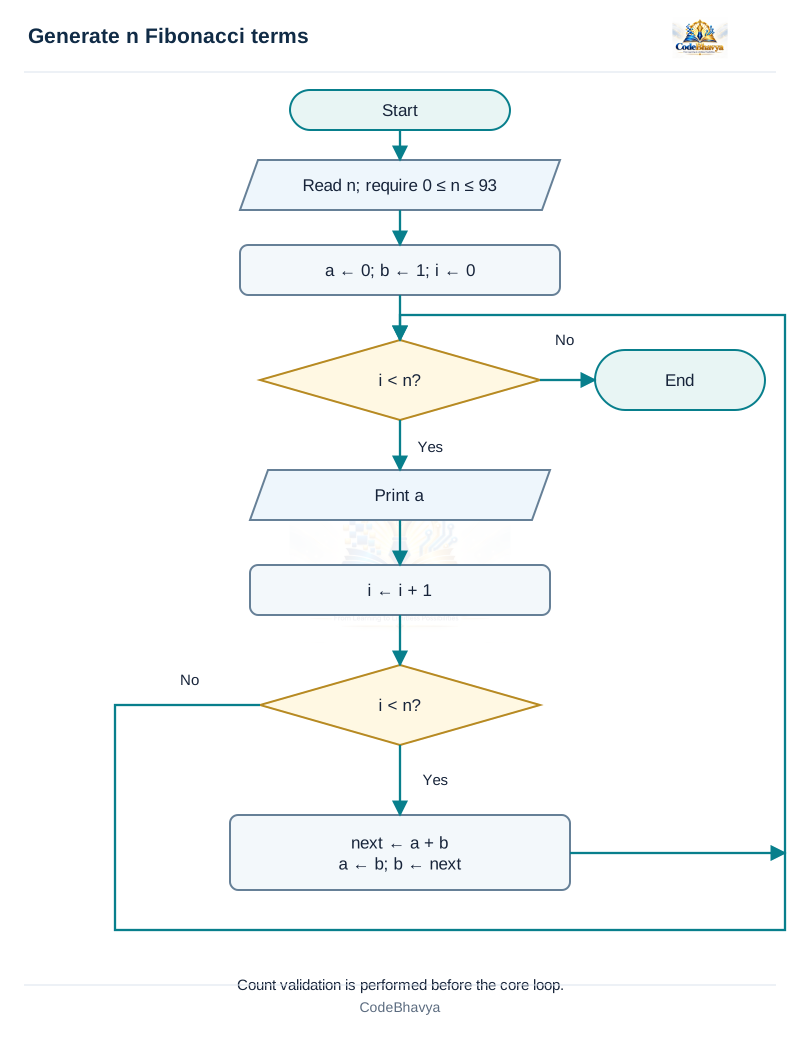
Develop an algorithm and flowchart to generate the first n Fibonacci terms.
5 marks
Answer in brief
A Fibonacci sequence begins with 0 and 1. Each later term is the sum of the two previous terms.
Algorithm
Read the count: Accept n, the number of terms required.
Set the starting values: Use a = 0, b = 1 and i = 0.
Print a: It is the next required term. Increase i by 1.
Update the pair if more terms are needed: First calculate next = a + b. Then set a = b and b = next.
Repeat: Continue until exactly n terms have been printed.
Example: first seven terms
The output is 0, 1, 1, 2, 3, 5, 8. After printing 0, the pair becomes 1 and 1. After printing the first 1, it becomes 1 and 2. Each new pair is prepared using the old pair. The count n means the number of terms, not the largest value allowed in the sequence.
Need for the temporary sum
Both old values are needed to calculate the next term. If a is replaced by b before the sum is calculated, the old a is lost. Saving next = a + b first avoids this mistake. The program does not calculate an extra unused term after the last output.
Boundary cases
For n = 0, no terms are printed. For n = 1, only 0 is printed. For n = 2, the result is 0 and 1. Negative counts are invalid. The supplied program accepts counts from 0 to 93 so that the values fit its unsigned long long variables.
Time and space complexity
The loop prints n terms and performs at most n − 1 pair updates. Therefore time is O(n). Only the count, counter and a few sequence values are stored, so extra space is O(1). This is an iterative method using a loop, not a recursive method.
/* CodeBhavya | PPS AR25 | Learning example */
#include <stdio.h>
int main(void)
{
    int n;
    if (scanf("%d", &n) != 1 || n < 0 || n > 93) {
        puts("Unsupported input"); return 1;
    }
    unsigned long long a = 0, b = 1;
    for (int i = 0; i < n; ++i) {
        printf("%s%llu", i == 0 ? "" : " ", a);
        if (i + 1 < n) {
            unsigned long long next = a + b;
            a = b; b = next;
        }
    }
    putchar('\n');
    return 0;
}
Sample input and output
Input
7
Output
0 1 1 2 3 5 8
Key points
Start with a = 0 and b = 1. Output the current a, then move to the next pair by computing the sum before overwriting either old value.
Calculate the next sum before replacing the old pair.
Related exam questions
Topic matches from the supplied JNTUH papers. Marks below are the printed allocations for those questions.
September/October 2021 · Q1(a) · 7 marks
What is flow chart? Draw a flowchart to generate Fibonacci sequence up to n numbers.