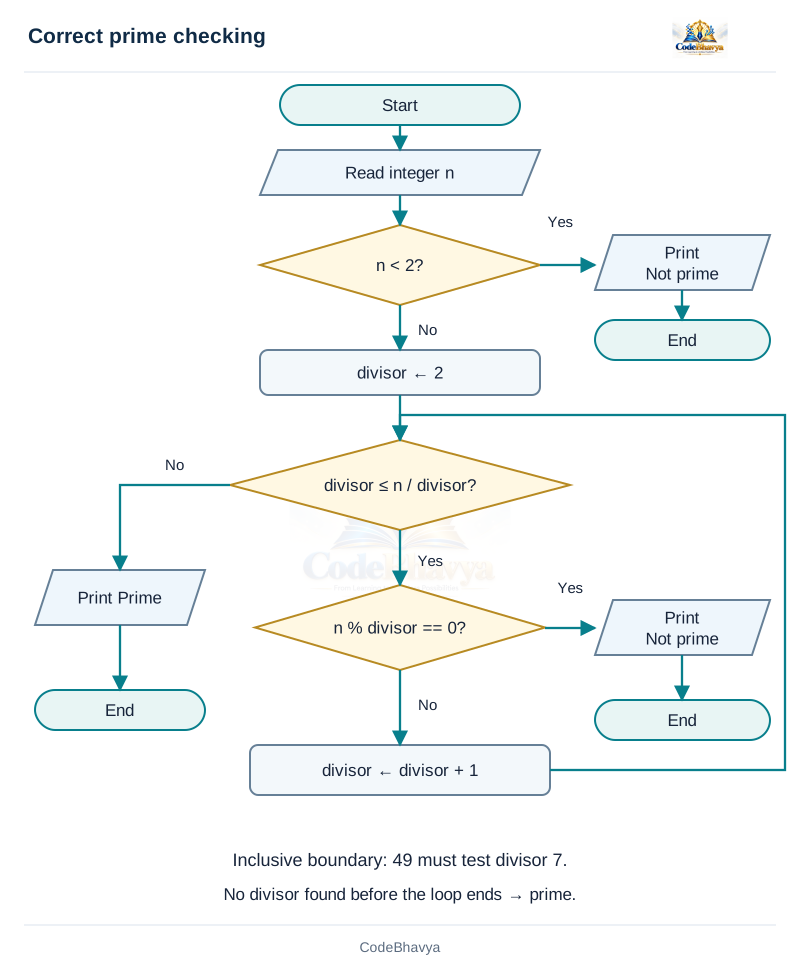
Develop a correct algorithm and flowchart to test whether an integer is prime.
5 marks
Answer in brief
A prime number is an integer greater than 1 whose only positive divisors are 1 and itself.
Algorithm
Handle small inputs: If n < 2, report Not prime.
Start testing: Set divisor = 2.
Test possible divisors: Continue while divisor <= n / divisor.
Check the remainder: If n % divisor == 0, report Not prime and stop.
Increase divisor: If it does not divide n, test the next integer.
Report Prime: If the tests finish without finding a divisor, n is prime.
Reason for the square-root limit
If n has a factor pair a × b = n, at least one factor is not greater than √n. Otherwise their product would be greater than n. So it is enough to look for a divisor up to and including √n. The program uses divisor <= n / divisor instead of multiplying divisor by itself, to avoid a possible multiplication overflow.
Examples
For n = 29, the values 2, 3, 4 and 5 do not divide it. The number is prime. For n = 49, divisor 7 gives a zero remainder, so 49 is not prime. The boundary must include 7. The values 0 and 1 are not prime, while 2 is prime.
Common mistakes
Testing only divisibility by 2 misses odd composite numbers such as 9 and 25. Stopping before the square-root boundary misses perfect squares such as 49. Also, do not count divisors only up to n/2 and then expect two divisors; that mixes two different methods.
Time and space complexity
In the worst case, about √n possible divisors are checked. Hence time is O(√n), where n is the number being tested. A fixed number of variables is used, so extra space is O(1).