QUESTION 08
Explain singly linked-list representation, creation and traversal.
5 marksAnswer in brief
A singly linked list connects nodes in one forward direction.
Node
struct Node { int data; struct Node *next; };Creation
Start head as NULL. Allocate a node, check success, assign its data and link it into the sequence. The complete example uses a tail pointer while building a known demonstration list so that each append needs only fixed link work. If allocation fails, release already owned nodes.
Traversal
- Set current to head.
- While current is not NULL, process current->data.
- Move current to current->next.
- Stop at NULL without dereferencing it.
Example
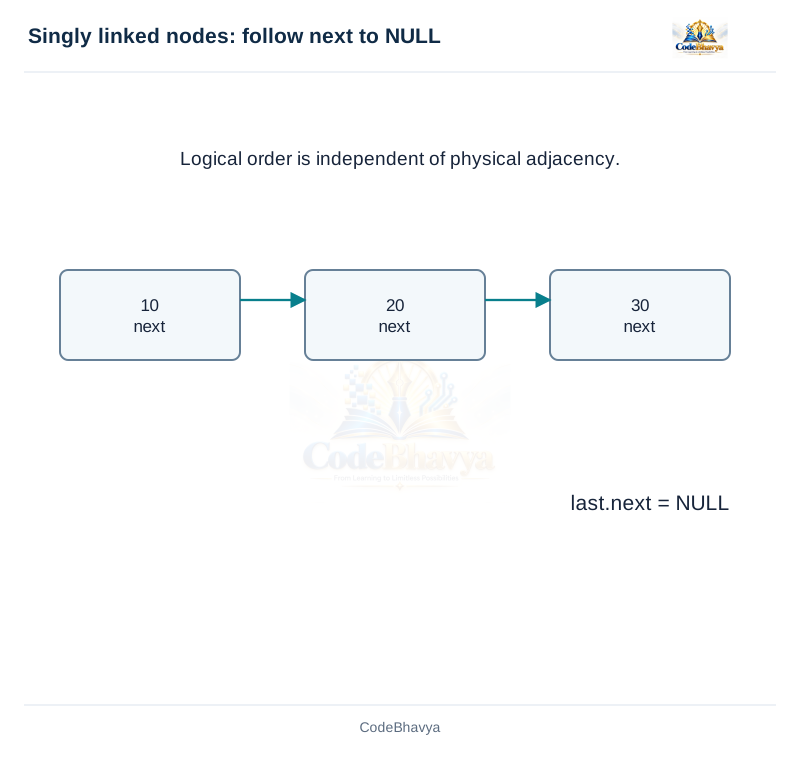
For 10 → 20 → 30 → NULL, traversal displays 10, 20 and 30. No assumption is made about the numerical memory addresses or physical adjacency of the nodes. An empty head makes the traversal body execute zero times.
Cleanup
Before freeing a node during traversal, save its next link in a separate pointer. Once freed, the old node must not be accessed to obtain the next value. After destroying the list, restore the owner’s head and tail to a valid empty state.
Complexity
Visiting n nodes takes O(n) time and a fixed current pointer gives O(1) auxiliary traversal space. The nodes occupy O(n) storage. Building by a maintained tail is O(n) link work, whereas repeatedly scanning from head to append can make construction O(n²), excluding allocator costs.
Diagram or flowchart
Complete C example
main.c
/* CodeBhavya | Data Structures AR25 | Learning example */
#include <stdio.h>
#include <stdlib.h>
struct Node { int data; struct Node *next; };
void destroy(struct Node *head)
{
    while (head != NULL) { struct Node *next = head->next; free(head); head = next; }
}
int append(struct Node **head, struct Node **tail, int value)
{
    struct Node *node = malloc(sizeof *node);
    if (node == NULL) { return 0; }
    node->data = value; node->next = NULL;
    if (*tail != NULL) { (*tail)->next = node; } else { *head = node; }
    *tail = node;
    return 1;
}
void display(const struct Node *head)
{
    const struct Node *p = head;
    while (p != NULL) { printf("%d%s", p->data, p->next == NULL ? "\n" : " "); p = p->next; }
    if (head == NULL) { puts("Empty"); }
}
int delete_first(struct Node **head, struct Node **tail, int value)
{
    struct Node *current = *head, *previous = NULL;
    while (current != NULL && current->data != value) { previous = current; current = current->next; }
    if (current == NULL) { return 0; }
    if (previous != NULL) { previous->next = current->next; } else { *head = current->next; }
    if (*tail == current) { *tail = previous; }
    free(current);
    return 1;
}

int main(void)
{
    struct Node *head = NULL, *tail = NULL;
    for (int value = 10; value <= 30; value += 10) {
        if (!append(&head, &tail, value)) { destroy(head); puts("Allocation failed"); return 1; }
    }
    display(head);
    delete_first(&head, &tail, 20);
    display(head);
    destroy(head);
    head = tail = NULL;
    return 0;
}
Sample input and output
The example uses values in the code.
Output
10 20 30
10 30
Related exam questions
The following are topic matches from the supplied papers. Marks are their printed allocations, separate from the practice answer badge.
- February 2024 · Q1(a) · 1 marks
Define a singly linked list.
Paper DS03 · page 1 - March 2021 · Q1(a) · 7 marks
Discuss singly linked lists.
Paper DS04 · page 1 - March 2022 · Q1(a) · 8 marks
Define a singly linked list and show its node structure and sketch.
Paper DS05 · page 1