QUESTION 13
How does a circular singly linked list end?
2 marksAnswer
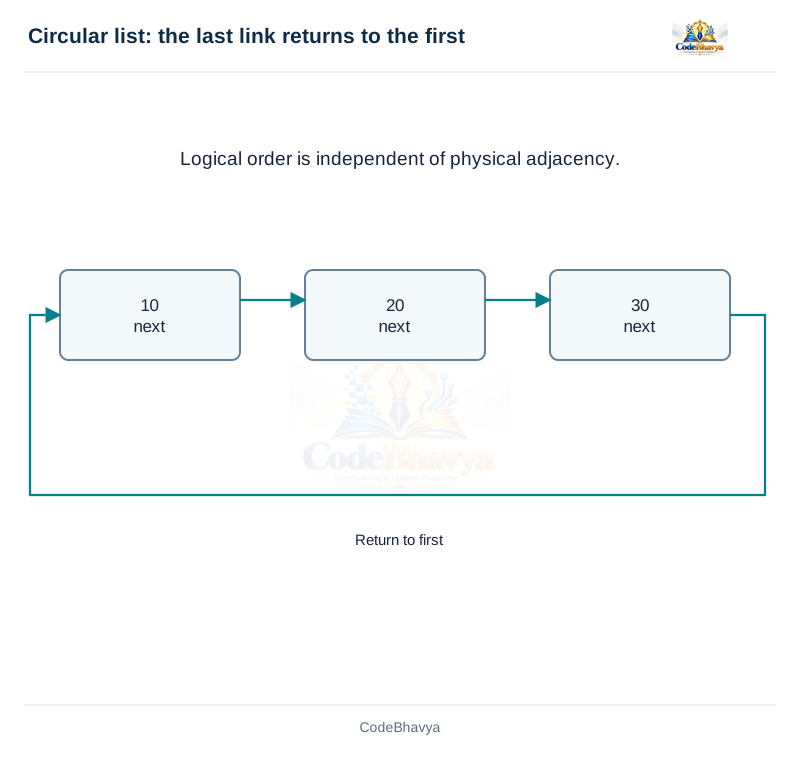
Its last node links back to the first instead of NULL. A separate empty representation, such as tail == NULL, is needed.
QUESTION 13
Its last node links back to the first instead of NULL. A separate empty representation, such as tail == NULL, is needed.
QUESTION 14
A circular singly linked list forms a forward cycle through all its nodes.
With a non-empty tail pointer, the first node is tail->next. The only node in a one-node list points to itself. This representation gives convenient access to both the tail and the beginning without walking through the list.
For a non-empty list, save start = tail->next. Process nodes and move forward until the pointer returns to start. A do-while form expresses the first valid visit. Testing only for NULL would not stop a normal circular traversal.
Handle an empty list separately. When removing the only node, free it and set tail = NULL. Otherwise bypass the target through its predecessor and update tail if the target was the tail. The resulting final link must still reach the current first node.
Circular lists suit round-robin scheduling and repeated cycling through participants. Head insertion or tail append with this representation needs O(1) link work; a value search can require O(n). Traversal visits each node once and uses O(1) auxiliary pointers. A broken termination rule can loop indefinitely.
/* CodeBhavya | Data Structures AR25 | Learning example */
#include <stdio.h>
#include <stdlib.h>
struct Node { int data; struct Node *next; };
int append(struct Node **tail, int value)
{
    struct Node *node = malloc(sizeof *node);
    if (node == NULL) { return 0; }
    node->data = value;
    if (*tail == NULL) { node->next = node; }
    else { node->next = (*tail)->next; (*tail)->next = node; }
    *tail = node; return 1;
}
int remove_front(struct Node **tail, int *out)
{
    if (*tail == NULL) { return 0; }
    struct Node *first = (*tail)->next; *out = first->data;
    if (first == *tail) { *tail = NULL; }
    else { (*tail)->next = first->next; }
    free(first); return 1;
}
void display(const struct Node *tail)
{
    if (tail == NULL) { puts("Empty"); return; }
    const struct Node *first = tail->next, *p = first;
    do { printf("%d%s", p->data, p->next == first ? "\n" : " "); p = p->next; } while (p != first);
}

int main(void)
{
    struct Node *tail = NULL; int value;
    for (int i = 10; i <= 30; i += 10) {
        if (!append(&tail, i)) {
            while (remove_front(&tail, &value)) { }
            puts("Allocation failed"); return 1;
        }
    }
    display(tail); remove_front(&tail, &value); display(tail);
    while (remove_front(&tail, &value)) { }
    return 0;
}The example uses values in the code.
10 20 30
20 30