QUESTION 01
What is an ADT?
2 marksAnswer
An abstract data type specifies a collection of values and permitted operations by their behaviour, without requiring one particular storage representation.

AR25 · I Year II Semester · Unit III — Introduction to Data Structures
QUESTION 01
An abstract data type specifies a collection of values and permitted operations by their behaviour, without requiring one particular storage representation.
QUESTION 02
An ADT describes what operations mean. An implementation supplies the concrete representation and algorithms.
A stack interface can provide push, pop, peek and is_empty. Its rule is last-in, first-out. A client should obtain the most recently pushed remaining value from pop, regardless of whether the stack uses an array or linked nodes.
An array stack can keep an element array and a top index. A linked stack can keep a head pointer and allocate nodes. Both can satisfy the same abstract rule, but have different capacity, allocation and locality properties. An ADT is not just a C struct declaration: behaviour is part of the definition.
The client can use operations without rewriting representation logic. Testing can verify observable behaviour. An implementation can be replaced while keeping a compatible contract. In C, headers and carefully designed functions support this separation, although C does not automatically enforce every abstraction boundary.
An ADT description should not be confused with an unconditional performance promise. The chosen implementation determines operation costs. Document those costs separately; for example, the array and linked stack versions shown later provide O(1) push/pop excluding allocator internals.
QUESTION 03
Consider the required operations and their frequency, as well as data size, memory limits, order requirements and expected growth.
QUESTION 04
Choose a structure by the operations the application must perform, rather than by which structure looks most advanced.
A fixed table of marks suits an array because indexed access is direct. A changing sequence with frequent head insertion can suit a linked list. A reverse-order undo history suggests a stack, while arrival-order work suggests a queue. Relationships between cities suggest a graph.
Arrays have contiguous storage and efficient indexed access, but a middle insertion can require shifting. Linked nodes can be relinked efficiently when the relevant location is known, but finding that location may require traversal and each node carries link storage.
Compare whole workloads, not one isolated best-case operation. An operation that first searches n nodes and then relinks one link still has O(n) total search-and-update work. Include input storage, output storage and auxiliary storage deliberately rather than mixing those categories.
State the expected workload, choose a simple correct representation, define an interface, then test boundary cases. A more complicated structure can add maintenance cost without helping a small task. The selected structure must also represent the required logical relationships accurately.
QUESTION 05
It is a finite ordered sequence of elements, where each non-end element has a logical predecessor or successor as appropriate. It need not be numerically sorted.
QUESTION 06
A linear list arranges elements in a logical sequence with a first and last position.
In an array list, consecutive logical positions normally occupy consecutive element positions. In a linked list, explicit links describe the sequence even when nodes are physically separate. Neither representation requires the values themselves to be sorted.
The list 10, 30, 20 has a first value 10 and last value 20. Inserting 15 after the first value produces 10, 15, 30, 20. Deleting 30 produces 10, 15, 20. The operation contract should specify whether positions are zero-based and whether duplicate values are allowed.
An empty list has no first element to read or remove. Insertion can create its first element. Deleting the only element must restore a valid empty representation. Reject invalid positions rather than writing outside storage or following a missing link.
The logical list does not prescribe one performance table. Arrays support O(1) indexed retrieval but may shift O(n) elements on insertion. Singly linked lists require O(n) indexed traversal, while head insertion uses O(1) link work. Choose and document the implementation.
QUESTION 07
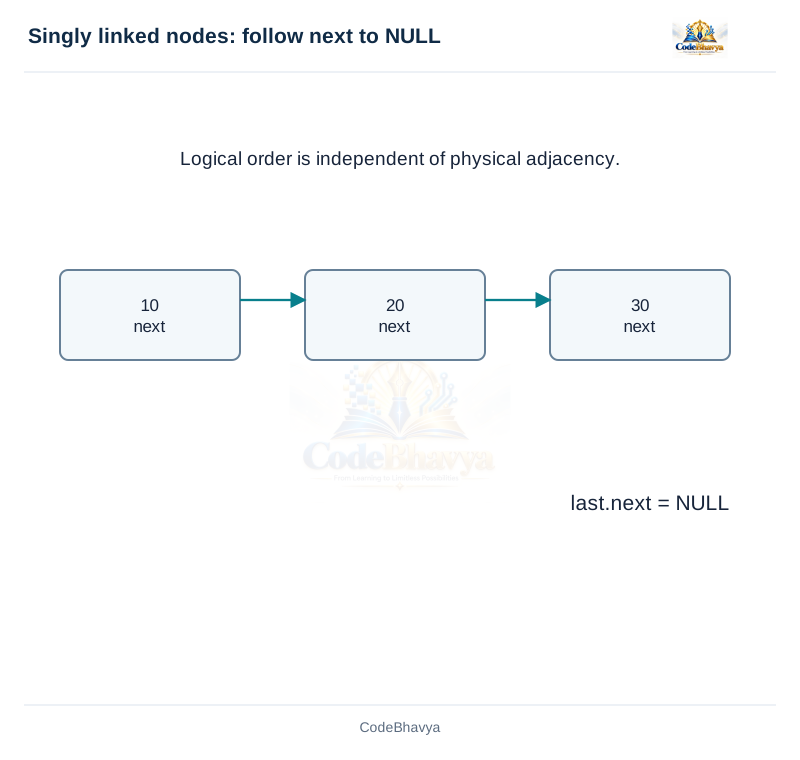
It contains data and a next link identifying the following node. A head pointer identifies the first node; NULL represents an empty list.
QUESTION 08
A singly linked list connects nodes in one forward direction.
struct Node { int data; struct Node *next; };Start head as NULL. Allocate a node, check success, assign its data and link it into the sequence. The complete example uses a tail pointer while building a known demonstration list so that each append needs only fixed link work. If allocation fails, release already owned nodes.
For 10 → 20 → 30 → NULL, traversal displays 10, 20 and 30. No assumption is made about the numerical memory addresses or physical adjacency of the nodes. An empty head makes the traversal body execute zero times.
Before freeing a node during traversal, save its next link in a separate pointer. Once freed, the old node must not be accessed to obtain the next value. After destroying the list, restore the owner’s head and tail to a valid empty state.
Visiting n nodes takes O(n) time and a fixed current pointer gives O(1) auxiliary traversal space. The nodes occupy O(n) storage. Building by a maintained tail is O(n) link work, whereas repeatedly scanning from head to append can make construction O(n²), excluding allocator costs.
/* CodeBhavya | Data Structures AR25 | Learning example */
#include <stdio.h>
#include <stdlib.h>
struct Node { int data; struct Node *next; };
void destroy(struct Node *head)
{
    while (head != NULL) { struct Node *next = head->next; free(head); head = next; }
}
int append(struct Node **head, struct Node **tail, int value)
{
    struct Node *node = malloc(sizeof *node);
    if (node == NULL) { return 0; }
    node->data = value; node->next = NULL;
    if (*tail != NULL) { (*tail)->next = node; } else { *head = node; }
    *tail = node;
    return 1;
}
void display(const struct Node *head)
{
    const struct Node *p = head;
    while (p != NULL) { printf("%d%s", p->data, p->next == NULL ? "\n" : " "); p = p->next; }
    if (head == NULL) { puts("Empty"); }
}
int delete_first(struct Node **head, struct Node **tail, int value)
{
    struct Node *current = *head, *previous = NULL;
    while (current != NULL && current->data != value) { previous = current; current = current->next; }
    if (current == NULL) { return 0; }
    if (previous != NULL) { previous->next = current->next; } else { *head = current->next; }
    if (*tail == current) { *tail = previous; }
    free(current);
    return 1;
}

int main(void)
{
    struct Node *head = NULL, *tail = NULL;
    for (int value = 10; value <= 30; value += 10) {
        if (!append(&head, &tail, value)) { destroy(head); puts("Allocation failed"); return 1; }
    }
    display(head);
    delete_first(&head, &tail, 20);
    display(head);
    destroy(head);
    head = tail = NULL;
    return 0;
}The example uses values in the code.
10 20 30
10 30The following are topic matches from the supplied papers. Marks are their printed allocations, separate from the practice answer badge.
Define a singly linked list.
Paper DS03 · page 1Discuss singly linked lists.
Paper DS04 · page 1Define a singly linked list and show its node structure and sketch.
Paper DS05 · page 1QUESTION 09
Set new_node->next to the old head, then make head identify the new node. Check allocation before changing the list.
QUESTION 10
Insertion creates a node and reconnects links. Deletion disconnects a selected node and releases its storage when the list owns it.
Set the new node’s next to NULL. If the list is empty, set head to it. Otherwise follow links to the final node and set its next to the new node. A maintained tail avoids that search. Do not lose the old head while traversing.
Deleting 20 from 10 → 20 → 30 links the 10 node directly to the 30 node before freeing the 20 node. Deleting 10 instead changes head. Deleting the sole node leaves head equal to NULL.
Head insertion is O(1) link work. End insertion without a tail and value-based deletion can each need O(n) search. Once the relevant predecessor is already known, unlinking is O(1). Node storage grows with the list; the fixed search pointers add O(1) auxiliary space. The demonstration program includes creation, append, delete, traversal and cleanup.
/* CodeBhavya | Data Structures AR25 | Learning example */
#include <stdio.h>
#include <stdlib.h>
struct Node { int data; struct Node *next; };
void destroy(struct Node *head)
{
    while (head != NULL) { struct Node *next = head->next; free(head); head = next; }
}
int append(struct Node **head, struct Node **tail, int value)
{
    struct Node *node = malloc(sizeof *node);
    if (node == NULL) { return 0; }
    node->data = value; node->next = NULL;
    if (*tail != NULL) { (*tail)->next = node; } else { *head = node; }
    *tail = node;
    return 1;
}
void display(const struct Node *head)
{
    const struct Node *p = head;
    while (p != NULL) { printf("%d%s", p->data, p->next == NULL ? "\n" : " "); p = p->next; }
    if (head == NULL) { puts("Empty"); }
}
int delete_first(struct Node **head, struct Node **tail, int value)
{
    struct Node *current = *head, *previous = NULL;
    while (current != NULL && current->data != value) { previous = current; current = current->next; }
    if (current == NULL) { return 0; }
    if (previous != NULL) { previous->next = current->next; } else { *head = current->next; }
    if (*tail == current) { *tail = previous; }
    free(current);
    return 1;
}

int main(void)
{
    struct Node *head = NULL, *tail = NULL;
    for (int value = 10; value <= 30; value += 10) {
        if (!append(&head, &tail, value)) { destroy(head); puts("Allocation failed"); return 1; }
    }
    display(head);
    delete_first(&head, &tail, 20);
    display(head);
    destroy(head);
    head = tail = NULL;
    return 0;
}The example uses values in the code.
10 20 30
10 30The complete program keeps a head pointer and a tail pointer. Consider three separately allocated nodes holding 10, 20, 30. Head identifies 10 and tail identifies 30. Delete the first node whose value is 30.
| Stage | previous | current | Action |
|---|---|---|---|
| Start | NULL | 10 | The first value does not match |
| Move once | 10 | 20 | The second value does not match |
| Move again | 20 | 30 | The value matches |
| Reconnect | 20 | 30 | Set previous->next to NULL and tail to previous |
| Release | 20 | No longer usable | Free the removed node; the list contains 10, 20 |
Changing only previous->next would leave tail pointing to freed storage. A later append could then write through that invalid pointer. The tail update is part of the deletion, even though traversal from head might initially look correct.
10, 20, 20, deleting 20 leaves 10, 20.A tail pointer makes appending convenient, but it does not tell us which node comes before a requested value. Value-based deletion may inspect every node. Reconnecting the links is fixed work after the match and its predecessor have been found.
The following are topic matches from the supplied papers. Marks are their printed allocations, separate from the practice answer badge.
Give singly linked-list insertion and deletion algorithms.
Paper DS03 · page 1Give insertion and deletion algorithms for a singly linked list.
Paper DS06 · page 1Give an algorithm to insert a node at the last position of a linear linked list.
Paper DS07 · page 1QUESTION 11
Scan the entire list, remembering the most recent matching node and its predecessor. Do not stop at the first match.
QUESTION 12
The supplied student-list question can be implemented as deletion of the final node whose key equals the selected student ID.
For IDs 7, 2, 7, 3 and key 7, the first saved match is the head. At the third node, the saved pair is replaced. After scanning the whole list, bypass the third node. The result is 7, 2, 3, preserving the earlier occurrence.
An empty list and an absent key produce no deletion. A single matching node is removed and head becomes NULL. If the last occurrence is also the last node, its predecessor’s next becomes NULL. A representation with a tail pointer must update that tail too.
The paper uses a student scenario without a full record schema. The algorithm treats the student identifier as the key; it does not decide attendance policy or infer a person’s identity from a name.
Every node must be examined to establish that a match is the last, giving O(n) time. A fixed number of remembered pointers gives O(1) auxiliary space.
/* CodeBhavya | Data Structures AR25 | Learning example */
#include <stdio.h>
#include <stdlib.h>
struct Node { int data; struct Node *next; };
void destroy(struct Node *head)
{
    while (head != NULL) { struct Node *next = head->next; free(head); head = next; }
}
int append(struct Node **head, struct Node **tail, int value)
{
    struct Node *node = malloc(sizeof *node);
    if (node == NULL) { return 0; }
    node->data = value; node->next = NULL;
    if (*tail != NULL) { (*tail)->next = node; } else { *head = node; }
    *tail = node;
    return 1;
}
void display(const struct Node *head)
{
    const struct Node *p = head;
    while (p != NULL) { printf("%d%s", p->data, p->next == NULL ? "\n" : " "); p = p->next; }
    if (head == NULL) { puts("Empty"); }
}
int delete_last(struct Node **head, struct Node **tail, int key)
{
    struct Node *current = *head, *previous = NULL, *last = NULL, *last_previous = NULL;
    while (current != NULL) {
        if (current->data == key) { last = current; last_previous = previous; }
        previous = current; current = current->next;
    }
    if (last == NULL) { return 0; }
    if (last_previous != NULL) { last_previous->next = last->next; } else { *head = last->next; }
    if (*tail == last) { *tail = last_previous; }
    free(last); return 1;
}

int main(void)
{
    struct Node *head = NULL, *tail = NULL;
    int data[4] = {7, 2, 7, 3};
    for (int i = 0; i < 4; ++i) {
        if (!append(&head, &tail, data[i])) { destroy(head); puts("Allocation failed"); return 1; }
    }
    delete_last(&head, &tail, 7); display(head); destroy(head);
    return 0;
}The example uses values in the code.
7 2 3The following are topic matches from the supplied papers. Marks are their printed allocations, separate from the practice answer badge.
Write a function to delete the last occurrence of a student from a list.
Paper DS02 · page 1QUESTION 13
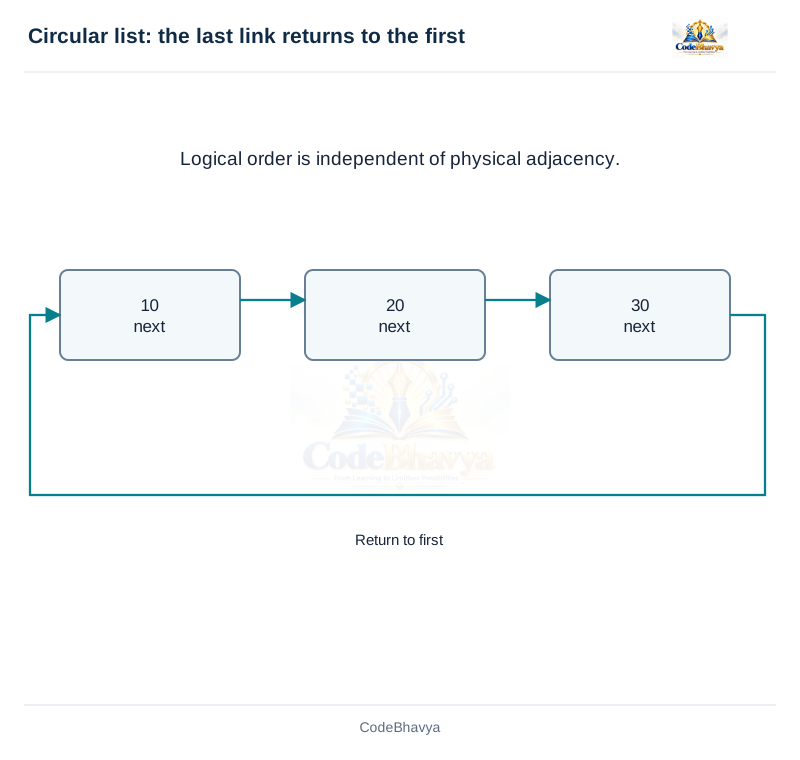
Its last node links back to the first instead of NULL. A separate empty representation, such as tail == NULL, is needed.
QUESTION 14
A circular singly linked list forms a forward cycle through all its nodes.
With a non-empty tail pointer, the first node is tail->next. The only node in a one-node list points to itself. This representation gives convenient access to both the tail and the beginning without walking through the list.
For a non-empty list, save start = tail->next. Process nodes and move forward until the pointer returns to start. A do-while form expresses the first valid visit. Testing only for NULL would not stop a normal circular traversal.
Handle an empty list separately. When removing the only node, free it and set tail = NULL. Otherwise bypass the target through its predecessor and update tail if the target was the tail. The resulting final link must still reach the current first node.
Circular lists suit round-robin scheduling and repeated cycling through participants. Head insertion or tail append with this representation needs O(1) link work; a value search can require O(n). Traversal visits each node once and uses O(1) auxiliary pointers. A broken termination rule can loop indefinitely.
/* CodeBhavya | Data Structures AR25 | Learning example */
#include <stdio.h>
#include <stdlib.h>
struct Node { int data; struct Node *next; };
int append(struct Node **tail, int value)
{
    struct Node *node = malloc(sizeof *node);
    if (node == NULL) { return 0; }
    node->data = value;
    if (*tail == NULL) { node->next = node; }
    else { node->next = (*tail)->next; (*tail)->next = node; }
    *tail = node; return 1;
}
int remove_front(struct Node **tail, int *out)
{
    if (*tail == NULL) { return 0; }
    struct Node *first = (*tail)->next; *out = first->data;
    if (first == *tail) { *tail = NULL; }
    else { (*tail)->next = first->next; }
    free(first); return 1;
}
void display(const struct Node *tail)
{
    if (tail == NULL) { puts("Empty"); return; }
    const struct Node *first = tail->next, *p = first;
    do { printf("%d%s", p->data, p->next == first ? "\n" : " "); p = p->next; } while (p != first);
}

int main(void)
{
    struct Node *tail = NULL; int value;
    for (int i = 10; i <= 30; i += 10) {
        if (!append(&tail, i)) {
            while (remove_front(&tail, &value)) { }
            puts("Allocation failed"); return 1;
        }
    }
    display(tail); remove_front(&tail, &value); display(tail);
    while (remove_front(&tail, &value)) { }
    return 0;
}The example uses values in the code.
10 20 30
20 30QUESTION 15
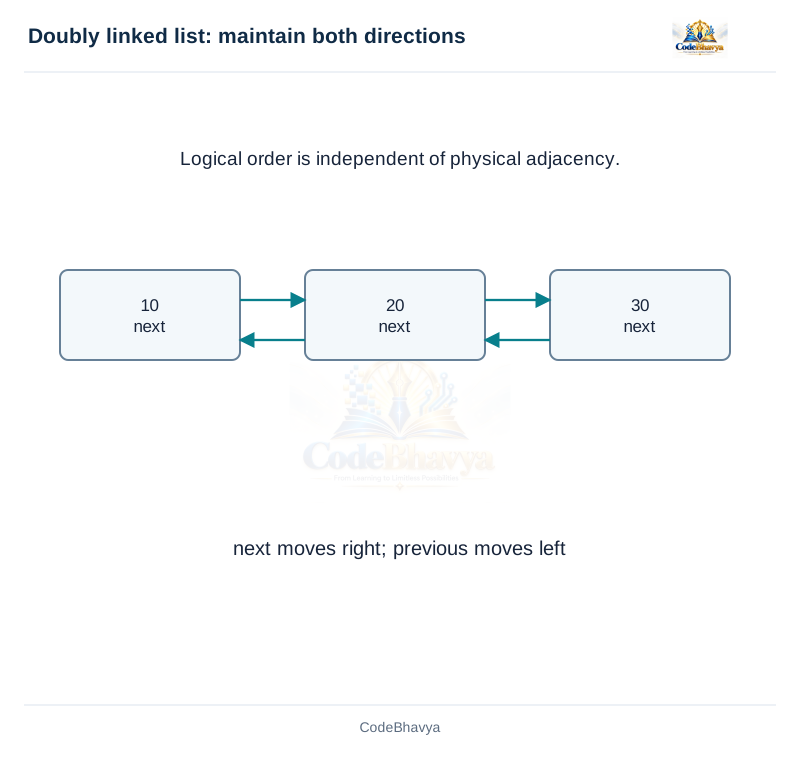
A previous link, in addition to data and next. It supports following the sequence in both directions when links are maintained correctly.
QUESTION 16
A doubly linked list stores links to both the previous and next nodes.
struct DNode {
    int data;
    struct DNode *previous, *next;
};For a new node between left and right, set new->previous = left and new->next = right. If left exists, set left->next = new; otherwise update head. If right exists, set right->previous = new; otherwise update tail. Both directions must describe the same sequence.
Link its predecessor’s next to its successor when a predecessor exists, otherwise update head. Link its successor’s previous to its predecessor when a successor exists, otherwise update tail. Only after reconnecting both sides should the removed owned node be freed.
Starting from head and following next displays forward order. Starting from tail and following previous displays reverse order. Do not dereference missing boundary neighbours; head->previous and tail->next are normally NULL in this non-circular form.
Deleting a known node uses O(1) link work because its predecessor is directly available. Searching by key still takes O(n). Nodes require an extra pointer compared with a singly linked representation, and each update must maintain more links. A single-node deletion sets both head and tail to NULL.
/* CodeBhavya | Data Structures AR25 | Learning example */
#include <stdio.h>
#include <stdlib.h>
struct Node { int data; struct Node *previous, *next; };
struct List { struct Node *head, *tail; };
int append(struct List *list, int value)
{
    struct Node *node = malloc(sizeof *node);
    if (node == NULL) { return 0; }
    node->data = value; node->next = NULL; node->previous = list->tail;
    if (list->tail != NULL) { list->tail->next = node; } else { list->head = node; }
    list->tail = node; return 1;
}
void remove_node(struct List *list, struct Node *node)
{
    if (node == NULL) { return; }
    if (node->previous != NULL) { node->previous->next = node->next; } else { list->head = node->next; }
    if (node->next != NULL) { node->next->previous = node->previous; } else { list->tail = node->previous; }
    free(node);
}
void destroy(struct List *list)
{
    while (list->head != NULL) { remove_node(list, list->head); }
}

int main(void)
{
    struct List list = {NULL, NULL};
    for (int i = 10; i <= 30; i += 10) {
        if (!append(&list, i)) { destroy(&list); puts("Allocation failed"); return 1; }
    }
    remove_node(&list, list.head->next);
    for (struct Node *p = list.head; p != NULL; p = p->next) { printf("%d%s", p->data, p->next == NULL ? "\n" : " "); }
    for (struct Node *p = list.tail; p != NULL; p = p->previous) { printf("%d%s", p->data, p->previous == NULL ? "\n" : " "); }
    destroy(&list);
    return 0;
}The example uses values in the code.
10 30
30 10QUESTION 17
An array list in the usual random-access model. Linked lists normally need traversal to reach an arbitrary index.
QUESTION 18
List representations trade direct access, link overhead and update convenience.
Contiguous elements permit direct indexed access and good locality. Fixed-capacity arrays need an overflow policy, while a dynamic array needs allocation management. Inserting or deleting in the middle can shift O(n) elements.
Each node has a next link. Head insertion needs O(1) link work, but finding an arbitrary position or predecessor may take O(n). Nodes can be allocated separately as the list grows, with allocation failures handled.
The last link returns to the first. A tail-based representation supports constant link work at the beginning and end and suits cycling tasks. Traversal must stop when it returns to its start, not when it sees NULL.
Each node has previous and next links. A known node can be removed using its neighbours without a predecessor search. More memory and more careful link updates are required. Searching by value remains linear.
Include the cost of locating a position before claiming an update is constant time. All n-element representations need O(n) data storage; linked representations add per-node links and allocator overhead. A maintained tail helps append but does not create random access. Choose the simplest representation meeting the required workload.
| Representation | Index lookup | Head insert | Extra links |
|---|---|---|---|
| Array | O(1) | O(n) shifts in general | None per element |
| Singly linked | O(n) | O(1) link work | One per node |
| Circular singly | O(n) | O(1) with tail representation | One per node |
| Doubly linked | O(n) | O(1) link work | Two per node |
QUESTION 19
Start at head and follow next links, comparing each node’s key. Stop at a match or NULL.
QUESTION 20
A linked list can be searched or counted by visiting its nodes in forward order.
Start count at zero. Increment it for every visited node. The empty list produces zero. If size is stored in the list descriptor instead, update it consistently on every successful insertion and deletion; a stale cached count is not useful.
For 10 → 20 → 30, a search for 20 makes two comparisons. A search for 99 visits all three nodes before reporting failure. Returning a node pointer does not transfer ownership automatically; its validity ends if the node is later removed or the list is destroyed.
A first-node match is O(1). The worst case is O(n), including a missing key. Counting without a cached size also takes O(n). A fixed current pointer and counter use O(1) auxiliary space.
Sorted list values can allow a forward scan to stop early once it passes the key, but ordinary linked nodes still do not provide constant-time middle access. The array binary-search algorithm cannot simply assume it can jump to any linked-list midpoint in O(1).