Write and explain a recursive C program to find factorial.
5 marks
Answer in brief
Recursive factorial uses the relationship n! = n × (n - 1)!, with 0! = 1.
Algorithm
Read n and accept values from 0 through 20.
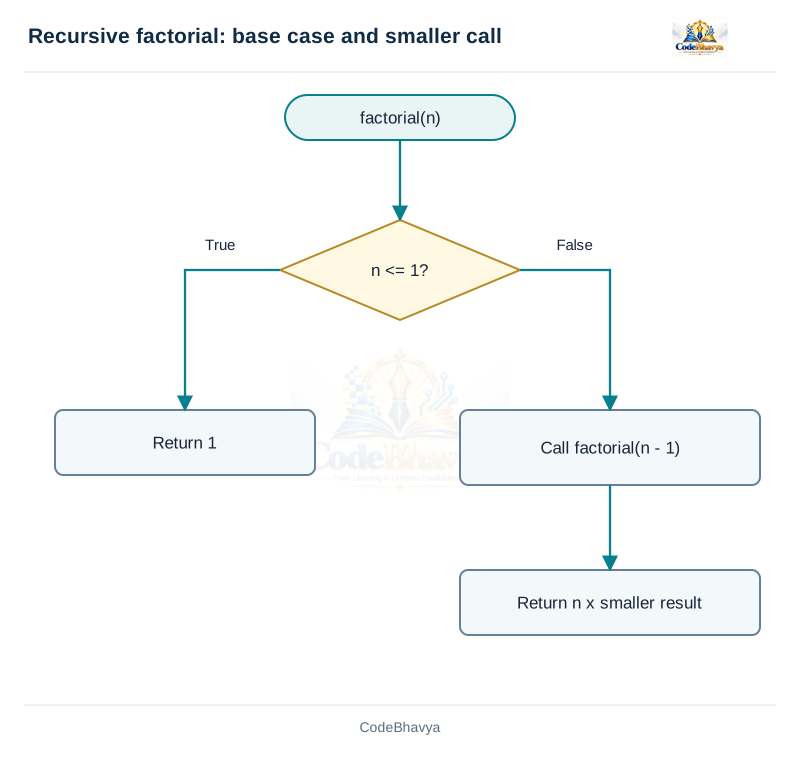
If n <= 1, return 1.
Otherwise, return n multiplied by factorial(n - 1).
Display the returned result.
Call and return trace
For n = 4, the calls ask for factorial(4), factorial(3), factorial(2) and factorial(1). The final call returns 1. The pending multiplications then produce 2 × 1 = 2, 3 × 2 = 6 and 4 × 6 = 24. The original call returns 24 to main.
Why it stops
Every recursive call decreases a supported positive n by one. It eventually reaches 1, which is a base case. Input zero is also handled by the base case. main rejects negative input before converting it to unsigned, preventing an unintended very large unsigned value.
Input and type limits
The result uses unsigned long long and the matching output format %llu. The supported limit 20 ensures that 20! fits the minimum range guaranteed for that type. A wider integer still has a finite range, so recursion cannot calculate arbitrary factorials accurately with this fixed type.
Time complexity
There is one smaller recursive call per level, with constant work apart from the call. The number of levels grows in proportion to n, giving O(n) time in the fixed-width model.
Space complexity
Pending calls wait for smaller results before multiplying. There are O(n) active calls in the usual call-record model, so auxiliary space is O(n). An iterative factorial can perform the same number of multiplications with O(1) auxiliary space.
Flowchart
Write and explain a recursive C program to find factorial. · Download diagram