QUESTION 11
What are the three BST deletion cases?
2 marksAnswer
The target has zero children, one child or two children. The two-child case uses a suitable predecessor or successor replacement.
QUESTION 11
The target has zero children, one child or two children. The two-child case uses a suitable predecessor or successor replacement.
QUESTION 12
BST deletion must remove the target while preserving every subtree’s ordering relationship.
The right-subtree minimum is greater than every key in the left subtree and no larger than the remaining right-subtree keys. It has no left child, so deleting its old node reduces to a simpler case. Do not copy a whole node object including its link pointers as though that were only a key replacement.
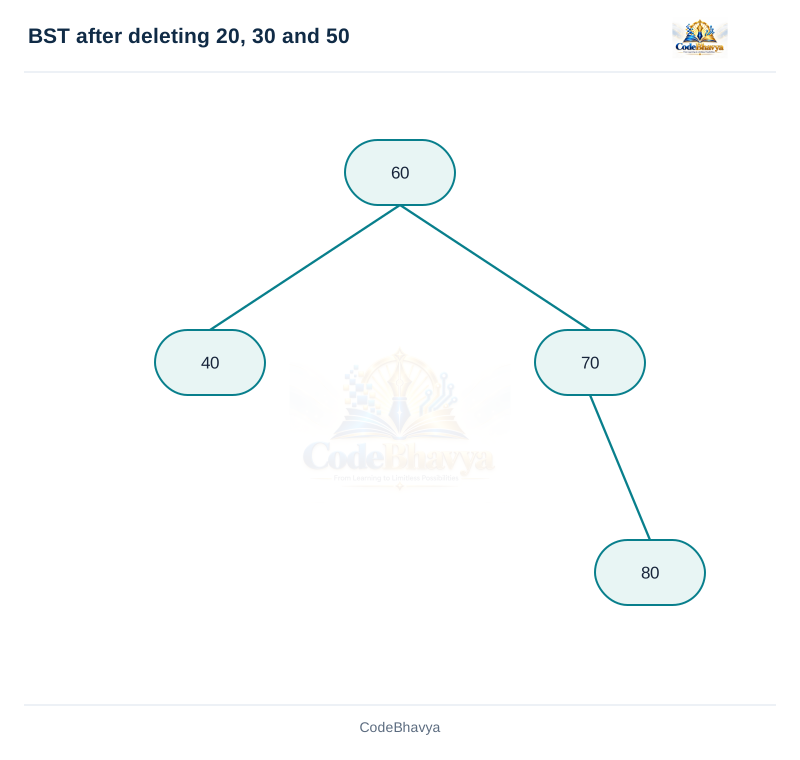
The demonstration builds 50, 30, 70, 20, 40, 60, 80. It deletes 20 as a leaf, 30 as a one-child node and 50 as a two-child root. The final inorder sequence is 40, 60, 70, 80.
Deleting the root can change the root pointer. Removing the only node makes the tree empty. Free exactly the removed node and keep no usable alias to it. A missing-key deletion is a normal unsuccessful operation.
Search and successor location follow paths bounded by tree height, giving O(h) time. Worst case is O(n), not unconditionally logarithmic. Recursive deletion uses O(h) call space. Destroy all remaining owned nodes when finished.
/* CodeBhavya | Data Structures AR25 | Learning example */
#include <stdio.h>
#include <stdlib.h>
struct Node { int key; struct Node *left, *right; };
struct Node *insert(struct Node *root, int key, int *ok)
{
    if (root == NULL) {
        struct Node *node = malloc(sizeof *node);
        if (node == NULL) { *ok = 0; return NULL; }
        node->key = key; node->left = node->right = NULL; return node;
    }
    if (key < root->key) { root->left = insert(root->left, key, ok); }
    else if (key > root->key) { root->right = insert(root->right, key, ok); }
    return root;
}
const struct Node *search(const struct Node *root, int key)
{
    while (root != NULL && root->key != key) { root = key < root->key ? root->left : root->right; }
    return root;
}
struct Node *remove_key(struct Node *root, int key)
{
    if (root == NULL) { return NULL; }
    if (key < root->key) { root->left = remove_key(root->left, key); }
    else if (key > root->key) { root->right = remove_key(root->right, key); }
    else {
        if (root->left == NULL) { struct Node *next = root->right; free(root); return next; }
        if (root->right == NULL) { struct Node *next = root->left; free(root); return next; }
        struct Node *successor = root->right;
        while (successor->left != NULL) { successor = successor->left; }
        root->key = successor->key;
        root->right = remove_key(root->right, successor->key);
    }
    return root;
}
void inorder(const struct Node *root)
{
    if (root != NULL) { inorder(root->left); printf("%d ", root->key); inorder(root->right); }
}
void destroy(struct Node *root)
{
    if (root != NULL) { destroy(root->left); destroy(root->right); free(root); }
}

int main(void)
{
    struct Node *root = NULL; int ok = 1;
    int keys[7] = {50, 30, 70, 20, 40, 60, 80};
    for (int i = 0; i < 7; ++i) {
        root = insert(root, keys[i], &ok);
        if (!ok) { destroy(root); puts("Allocation failed"); return 1; }
    }
    printf("Search 40: %s\n", search(root, 40) != NULL ? "Found" : "Not found");
    root = remove_key(root, 20); root = remove_key(root, 30); root = remove_key(root, 50);
    inorder(root); putchar('\n'); destroy(root); root = NULL;
    return 0;
}The example uses values in the code.
Search 40: Found
40 60 70 80The following are topic matches from the supplied papers. Marks are their printed allocations, separate from the practice answer badge.
Give BST deletion algorithm with an example.
Paper DS03 · page 2Give BST deletion algorithm.
Paper DS06 · page 1