QUESTION 01
What is the stack access rule?
2 marksAnswer
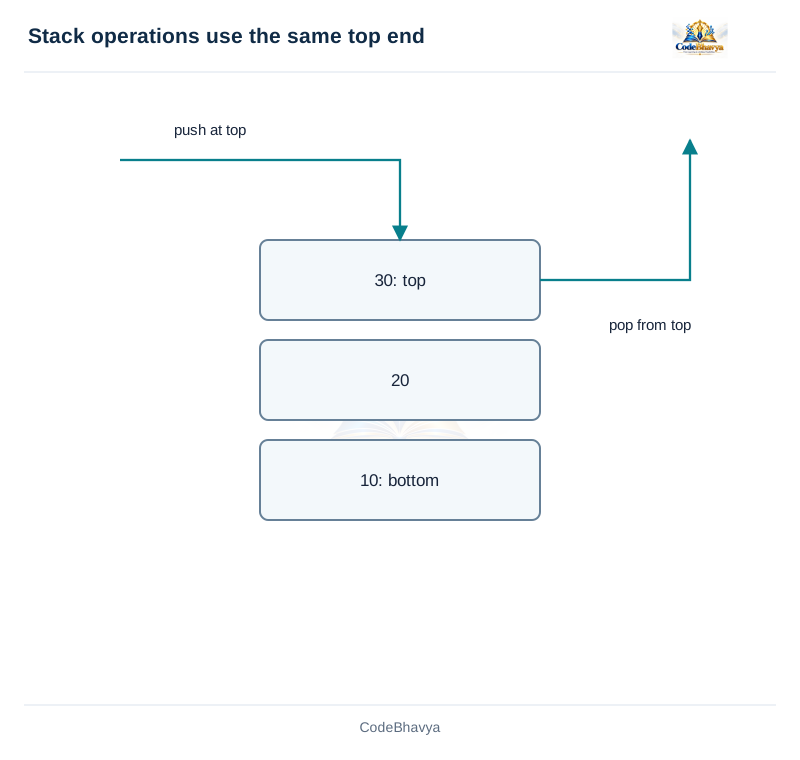
A stack follows last-in, first-out: the most recently inserted remaining value is removed first. All ordinary updates occur at its top.

AR25 · I Year II Semester · Unit IV — Stacks and Queues
QUESTION 01
A stack follows last-in, first-out: the most recently inserted remaining value is removed first. All ordinary updates occur at its top.
QUESTION 02
A stack supports push, pop and peek at one end called top.
Use an array of capacity CAP and an integer top initialised to -1. Empty means top == -1. Full means top == CAP - 1. Valid stored elements occupy indices 0 through top.
Overflow means a push cannot be accommodated by the chosen representation. Underflow means removal or reading was requested from an empty stack. Use a status result and a separate output parameter instead of a special data value that could also be a legitimate stored item.
Stacks support undo histories, nested calls, expression processing and backtracking. Their access order is different from a queue’s arrival-order rule. A stack is not automatically sorted by value.
A bounded array push, pop or peek needs a fixed number of tests and assignments, so each is O(1). Storage for capacity c is O(c). Traversing or printing all n elements is O(n). The complete program demonstrates successful operations; accompanying checks also exercise empty and full cases.
/* CodeBhavya | Data Structures AR25 | Learning example */
#include <stdio.h>
#define CAP 6
struct Stack { int values[CAP]; int top; };
int push(struct Stack *s, int value)
{
    if (s->top == CAP - 1) { return 0; }
    s->values[++s->top] = value; return 1;
}
int pop(struct Stack *s, int *out)
{
    if (s->top < 0) { return 0; }
    *out = s->values[s->top--]; return 1;
}
int peek(const struct Stack *s, int *out)
{
    if (s->top < 0) { return 0; }
    *out = s->values[s->top]; return 1;
}

int main(void)
{
    struct Stack s = {{0}, -1};
    int value;
    if (!push(&s, 10) || !push(&s, 20)) { puts("Full"); return 1; }
    if (pop(&s, &value)) { printf("Popped = %d\n", value); }
    if (peek(&s, &value)) { printf("Top = %d\n", value); }
    return 0;
}The example uses values in the code.
Popped = 20
Top = 10The following are topic matches from the supplied papers. Marks are their printed allocations, separate from the practice answer badge.
Give examples of a stack.
Paper DS01 · page 1Explain array-based push and pop.
Paper DS03 · page 1Write a program implementing stack operations.
Paper DS05 · page 1QUESTION 03
At the head, so push and pop can change the first link without searching for the last node.
QUESTION 04
A linked stack uses its head pointer as top and allocates one node per pushed item.
Pushing 10 then 20 creates 20 → 10 → NULL. Pop removes 20 first and leaves 10 as top. Removing the only remaining node makes top NULL. This matches the same LIFO contract as the array implementation.
There is no preset array capacity in this version, but memory is finite and malloc can fail. Calling it unlimited would be incorrect. Every successful push creates owned storage that must later be released by pop or destruction. Read the link before freeing its node.
Each operation uses O(1) link work, excluding the allocator’s implementation-dependent cost. A linked stack with n items needs O(n) node storage, including next links. It avoids shifting elements but adds allocation overhead and less predictable physical locality than an array.
/* CodeBhavya | Data Structures AR25 | Learning example */
#include <stdio.h>
#include <stdlib.h>
struct Node { int data; struct Node *next; };
int push(struct Node **top, int value)
{
    struct Node *node = malloc(sizeof *node);
    if (node == NULL) { return 0; }
    node->data = value; node->next = *top; *top = node; return 1;
}
int pop(struct Node **top, int *out)
{
    if (*top == NULL) { return 0; }
    struct Node *old = *top; *out = old->data; *top = old->next; free(old); return 1;
}

int main(void)
{
    struct Node *top = NULL;
    int value;
    if (!push(&top, 10) || !push(&top, 20)) {
        while (pop(&top, &value)) { }
        puts("Allocation failed"); return 1;
    }
    while (pop(&top, &value)) { printf("%d\n", value); }
    return 0;
}The example uses values in the code.
20
10The following are topic matches from the supplied papers. Marks are their printed allocations, separate from the practice answer badge.
Write and explain push and pop algorithms using a linked list.
Paper DS01 · page 1Implement a stack using a singly linked list.
Paper DS02 · page 1Write a program implementing a linked-list stack.
Paper DS06 · page 1QUESTION 05
It is 30. The initial bottom-to-top stack is 10, 20, 50, 30, 90, 60; apply the operations in order rather than sorting values.
QUESTION 06
A stack trace updates the logical top after every operation while preserving the untouched bottom portion.
Bottom to top: 10, 20, 50, 30, 90, 60. Capacity is 10 and the initial count is 6. The top is 60.
Bottom to top: 10, 20, 50, 30. Peek is 30 and does not remove it. The count is 4. None of these operations reaches empty or exceeds capacity, so there is no underflow or overflow.
Record the complete remaining sequence or a clear top marker after each step. Distinguish a newly pushed 30 from an earlier equal value if labels help, but the final requested value is still 30. Never remove the bottom item for pop; that would violate LIFO.
For k operations on the bounded array representation, each operation is O(1), so the trace requires O(k) work. This specific trace has a fixed eight operations. Writing every intermediate full stack for display can add output work beyond the stack operations themselves.
The following are topic matches from the supplied papers. Marks are their printed allocations, separate from the practice answer badge.
Starting stack bottom-to-top: 10, 20, 50, 30, 90, 60; capacity 10. Apply pop, push(30), push(40), pop, push(60), pop, pop, pop. Find the final peek value.
Paper DS02 · page 1Starting stack bottom-to-top: 10, 20, 50, 30, 90, 60; capacity 10. Apply pop, push(30), push(40), pop, push(60), pop, pop, pop. Find the final peek value.
Paper DS03 · page 1QUESTION 07
Their output must wait until operands and higher-precedence or appropriate same-precedence operators have been processed.
QUESTION 08
Postfix places each operator after its operands. A stack preserves pending infix operators and parentheses during conversion.
A + B - C * D * E / F - G becomes AB+CD*E*F/-G-. Multiplication and division are left-associative here. In the older paper’s A+B-C*D*E$F$G, interpret $ as the stated exponent operator with right associativity. The result is AB+CD*EFG$$*-. $ is notation for this exercise, not a standard C arithmetic operator.
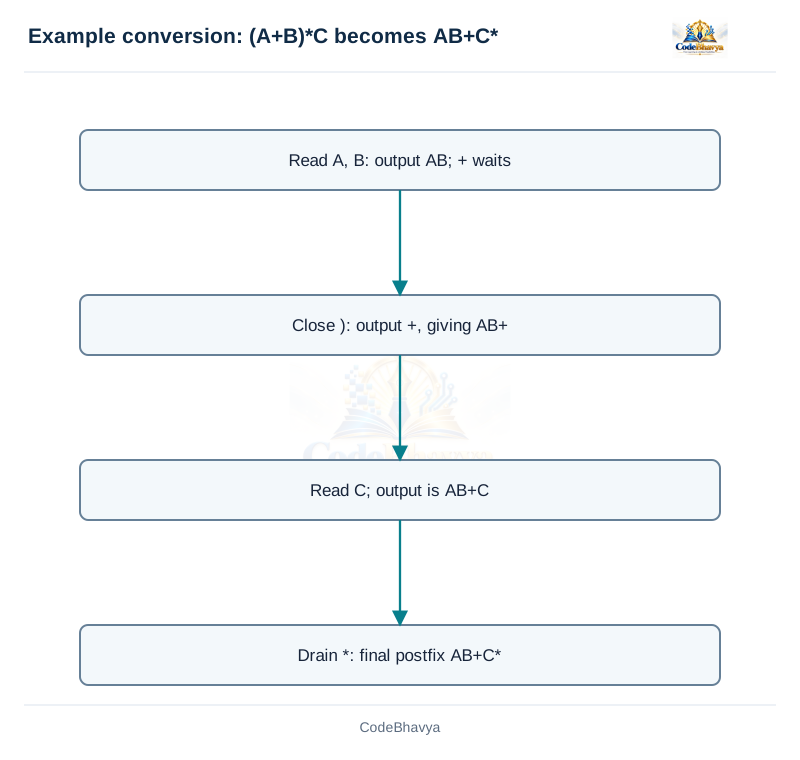
(A+B)*C becomes AB+C*. The parentheses require A+B to complete before the multiplication. Postfix needs no grouping parentheses because operand/operator order already records that grouping.
The complete converter accepts single ASCII letters or digits as operands, binary +, -, *, / and $, parentheses and spaces. It checks operand/operator order. It does not claim to parse unary minus, decimal numbers or multi-character variable names.
Each token is read once and each operator is pushed and popped at most once, giving O(n) token work and O(n) stack/output space. Parentheses and associativity must be handled correctly; comparing precedence alone is insufficient.
/* CodeBhavya | Data Structures AR25 | Learning example */
#include <stdio.h>
#include <string.h>
int read_line(char s[80])
{
    if (fgets(s, 80, stdin) == NULL) { return 0; }
    char *newline = strchr(s, '\n');
    if (newline != NULL) { *newline = '\0'; return 1; }
    int ch = getchar();
    if (ch == '\n' || ch == EOF) { return 1; }
    while ((ch = getchar()) != '\n' && ch != EOF) { }
    return 0;
}
int precedence(char op)
{
    if (op == '$') { return 3; }
    if (op == '*' || op == '/') { return 2; }
    if (op == '+' || op == '-') { return 1; }
    return 0;
}
int convert(const char input[], char output[80])
{
    char stack[80]; int top = -1, used = 0, need_operand = 1;
    for (int i = 0; input[i] != '\0'; ++i) {
        char ch = input[i];
        if (ch == ' ' || ch == '\t') { continue; }
        int operand = (ch >= 'A' && ch <= 'Z') || (ch >= 'a' && ch <= 'z') || (ch >= '0' && ch <= '9');
        if (operand) {
            if (!need_operand) { return 0; }
            output[used++] = ch; need_operand = 0;
        } else if (ch == '(') {
            if (!need_operand) { return 0; }
            stack[++top] = ch;
        } else if (ch == ')') {
            if (need_operand) { return 0; }
            while (top >= 0 && stack[top] != '(') { output[used++] = stack[top--]; }
            if (top < 0) { return 0; }
            --top;
        } else if (precedence(ch) != 0) {
            if (need_operand) { return 0; }
            while (top >= 0 && stack[top] != '(' &&
                   (precedence(stack[top]) > precedence(ch) ||
                   (precedence(stack[top]) == precedence(ch) && ch != '$'))) {
                output[used++] = stack[top--];
            }
            stack[++top] = ch; need_operand = 1;
        } else { return 0; }
    }
    if (need_operand) { return 0; }
    while (top >= 0) { if (stack[top] == '(') { return 0; } output[used++] = stack[top--]; }
    output[used] = '\0'; return 1;
}

int main(void)
{
    char input[80], output[80];
    if (!read_line(input) || !convert(input, output)) { puts("Invalid expression"); return 1; }
    puts(output);
    return 0;
}A+B-C*D*E/F-GAB+CD*E*F/-G-The following are topic matches from the supplied papers. Marks are their printed allocations, separate from the practice answer badge.
Convert A + B - C * D * E / F - G to postfix.
Paper DS03 · page 1Write a C program to convert infix to postfix.
Paper DS04 · page 1Convert A+B-C*D*E$F$G to postfix.
Paper DS06 · page 1QUESTION 09
The first popped value is the right operand; the second is the left. This order is essential for subtraction and division.
QUESTION 10
A postfix evaluator stores completed operand values and replaces each operator’s operands with its result.
For 5 3 + 6 2 / * 3 5 * +: 5 and 3 give 8; 6 and 2 give 3 by integer division; 8 * 3 gives 24; 3 and 5 give 15; 24 + 15 gives 39. The answer is 39.
Reject insufficient operands, a zero divisor, unsupported tokens or more than one remaining value. An empty expression has no result. For 2 8 -, the result is -6, not 6, because the first popped value is 8 and belongs on the right.
The supplied program uses whitespace-separated integer tokens and +, -, *, /. Each value and intermediate result is restricted to -1000000 through 1000000. The bound makes intermediate long long multiplication safe before the result check. It rejects out-of-range conversions and malformed tokens.
Each of n tokens causes a fixed number of stack operations, giving O(n) token work after numeric token parsing. The stack can hold O(n) values. Parsing also depends on the total input-character count. The bounded demonstration buffer limits resource use without changing the underlying algorithm.
/* CodeBhavya | Data Structures AR25 | Learning example */
#include <stdio.h>
#include <string.h>
#include <stdlib.h>
#include <errno.h>
int read_line(char s[80])
{
    if (fgets(s, 80, stdin) == NULL) { return 0; }
    char *newline = strchr(s, '\n');
    if (newline != NULL) { *newline = '\0'; return 1; }
    int ch = getchar();
    if (ch == '\n' || ch == EOF) { return 1; }
    while ((ch = getchar()) != '\n' && ch != EOF) { }
    return 0;
}
int evaluate(char input[], long long *out)
{
    long long stack[40]; int count = 0;
    char *token = strtok(input, " \t");
    while (token != NULL) {
        if (strlen(token) == 1 && strchr("+-*/", token[0]) != NULL) {
            if (count < 2) { return 0; }
            long long right = stack[--count], left = stack[--count], value;
            if (token[0] == '+') { value = left + right; }
            else if (token[0] == '-') { value = left - right; }
            else if (token[0] == '*') { value = left * right; }
            else { if (right == 0) { return 0; } value = left / right; }
            if (value < -1000000 || value > 1000000) { return 0; }
            stack[count++] = value;
        } else {
            char *end; errno = 0;
            long long value = strtoll(token, &end, 10);
            if (end == token || *end != '\0' || errno == ERANGE || value < -1000000 || value > 1000000 || count == 40) { return 0; }
            stack[count++] = value;
        }
        token = strtok(NULL, " \t");
    }
    if (count != 1) { return 0; }
    *out = stack[0]; return 1;
}

int main(void)
{
    char input[80];
    long long result;
    if (!read_line(input) || !evaluate(input, &result)) { puts("Invalid expression"); return 1; }
    printf("Result = %lld\n", result);
    return 0;
}5 3 + 6 2 / * 3 5 * +Result = 39The following are topic matches from the supplied papers. Marks are their printed allocations, separate from the practice answer badge.
Evaluate postfix 5 3 + 6 2 / * 3 5 * +, showing steps.
Paper DS07 · page 1QUESTION 11
The most recent unmatched opening bracket, with the same bracket type. Merely counting openings and closings is insufficient.
QUESTION 12
A bracket-balancing algorithm checks that nested grouping symbols close in the reverse order in which they open.
{[()]} is balanced. ([)] is not: the closing ) arrives while [ is on top. A simple equal-count check would miss that incorrect nesting. An unmatched closing symbol fails immediately, and leftover openings fail at the end.
The last unclosed opening must be the first one closed, which is exactly LIFO order. The stack records both the number and types of pending openings. A counter alone cannot describe every nested type combination.
The example checks grouping symbols in a bounded ordinary line and ignores other characters. It is not a complete C lexer: brackets inside string literals or comments are not specially ignored. State this distinction when applying the algorithm to source-code validation.
A line of n characters is scanned once. Each bracket is pushed or popped once, giving O(n) time. If every character is an opening symbol, the pending stack can contain O(n) symbols. The fixed-size demonstration stack matches its input capacity to avoid overflow.
/* CodeBhavya | Data Structures AR25 | Learning example */
#include <stdio.h>
#include <string.h>
int read_line(char s[80])
{
    if (fgets(s, 80, stdin) == NULL) { return 0; }
    char *newline = strchr(s, '\n');
    if (newline != NULL) { *newline = '\0'; return 1; }
    int ch = getchar();
    if (ch == '\n' || ch == EOF) { return 1; }
    while ((ch = getchar()) != '\n' && ch != EOF) { }
    return 0;
}
int balanced(const char text[])
{
    char stack[80]; int top = -1;
    for (int i = 0; text[i] != '\0'; ++i) {
        char ch = text[i];
        if (ch == '(' || ch == '[' || ch == '{') { stack[++top] = ch; }
        else if (ch == ')' || ch == ']' || ch == '}') {
            if (top < 0) { return 0; }
            char opening = stack[top--];
            if ((ch == ')' && opening != '(') || (ch == ']' && opening != '[') || (ch == '}' && opening != '{')) { return 0; }
        }
    }
    return top == -1;
}

int main(void)
{
    char text[80];
    if (!read_line(text)) { puts("Invalid input"); return 1; }
    puts(balanced(text) ? "Balanced" : "Unbalanced");
    return 0;
}{[()]}BalancedQUESTION 13
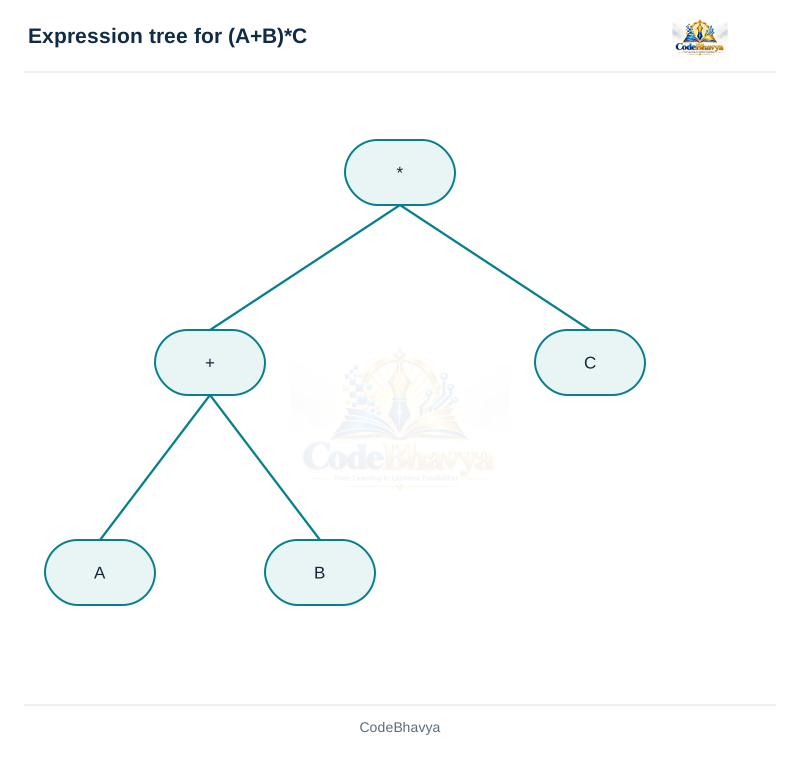
It is a tree with operands at leaves and operators at internal nodes. For binary operators, each operator has a left and right operand subtree.
QUESTION 14
An expression tree stores the structure of a calculation explicitly rather than relying only on a linear expression string.
For postfix AB+C*, first make leaves A and B and combine them under +. Then create C. Finally make * the root, with the + subtree on its left and C on its right. The tree represents (A+B)*C.
Preorder visits root, left and right, producing *+ABC. Postorder visits left, right and root, producing AB+C*. Inorder visits left, root and right. To preserve exact expression grouping, include suitable parentheses; plain unparenthesised inorder text can lose the tree’s grouping.
For a leaf, obtain its operand value. For an operator node, evaluate its left and right subtrees and apply the operator with valid arithmetic. Reject zero division and out-of-range calculations according to the chosen numeric representation.
Construction from n tokens uses O(n) node and stack space and O(n) structural work. Traversal visits each node once: O(n) time. Recursive traversal adds O(h) call depth for tree height h. Dynamically created nodes must be released when the tree is no longer needed.
QUESTION 15
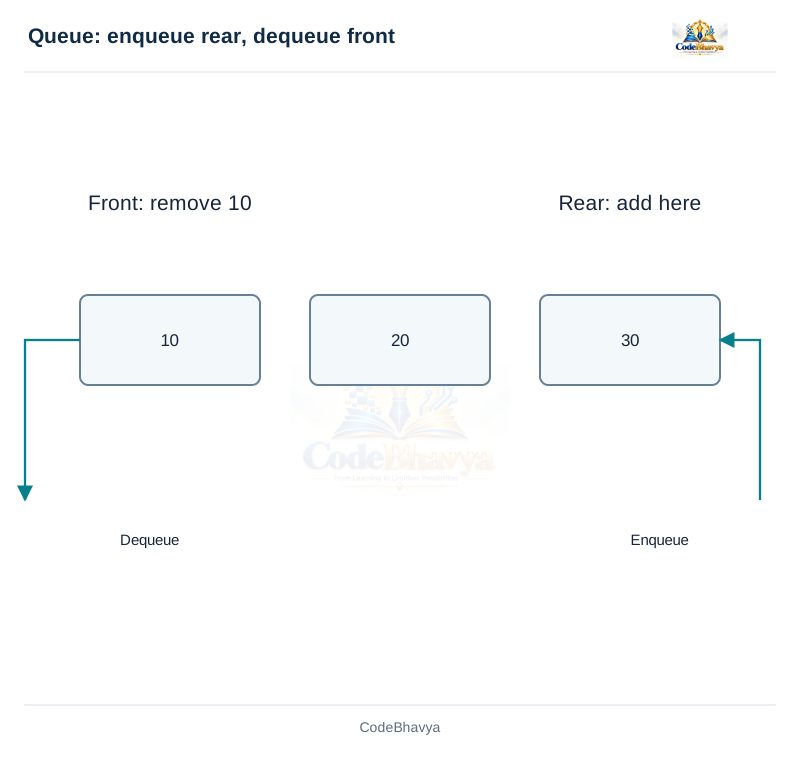
A queue follows first-in, first-out. enqueue adds at the rear and dequeue removes the earliest remaining item at the front.
QUESTION 16
A queue preserves arrival order and exposes front/rear operations rather than arbitrary middle removal.
Enqueue 10, then 20 and 30. The first dequeue returns 10, leaving 20 at the front. This differs from a stack, which would remove 30 first. Queue values need not be sorted by magnitude or priority.
A bounded array queue overflows when its capacity is exhausted. A linked queue can fail when node allocation fails. Underflow occurs when an empty queue is asked to remove or expose a front element. Return a status separately from the data value.
Queues model printer jobs, arrival-order service requests, buffered work and BFS traversal. A priority queue is a different contract that chooses by priority rather than ordinary FIFO arrival order.
A naive linear array can waste released front positions until reset or shifting occurs. A circular array reuses them with wraparound and gives O(1) enqueue/dequeue in the shown implementation. Printing n queued values takes O(n). Capacity c requires O(c) storage, with O(1) counters.
/* CodeBhavya | Data Structures AR25 | Learning example */
#include <stdio.h>
#define CAP 3
struct Queue { int data[CAP]; int front, count; };
int enqueue(struct Queue *q, int value)
{
    if (q->count == CAP) { return 0; }
    q->data[(q->front + q->count) % CAP] = value; ++q->count; return 1;
}
int dequeue(struct Queue *q, int *out)
{
    if (q->count == 0) { return 0; }
    *out = q->data[q->front]; q->front = (q->front + 1) % CAP; --q->count; return 1;
}

int main(void)
{
    struct Queue q = {{0}, 0, 0}; int value;
    if (!enqueue(&q, 10) || !enqueue(&q, 20) || !enqueue(&q, 30)) { return 1; }
    if (dequeue(&q, &value)) { printf("Removed = %d\n", value); }
    if (!enqueue(&q, 40)) { return 1; }
    while (dequeue(&q, &value)) { printf("%d\n", value); }
    return 0;
}The example uses values in the code.
Removed = 10
20
30
40The following are topic matches from the supplied papers. Marks are their printed allocations, separate from the practice answer badge.
Describe queue overflow and underflow conditions.
Paper DS01 · page 1Discuss applications of queues.
Paper DS01 · page 1Give queue applications.
Paper DS03 · page 1QUESTION 17
count == 0 means empty and count == capacity means full. This representation can use every array position.
QUESTION 18
A circular queue reuses the front positions of a bounded array after earlier items are removed.
Keep an array, front index and count. The next insertion index is (front + count) % capacity. This convention avoids confusing full and empty states when front and rear indices happen to be equal. Other valid conventions may reserve a slot and use different conditions.
With capacity 3, enqueue 10, 20 and 30, then dequeue 10. Enqueue 40 uses the newly available wrapped position. Logical order is 20, 30, 40 even though physical index order has wrapped. Display from front for count elements, applying modulo.
Each operation performs fixed work, giving O(1) time. The array uses O(capacity) storage. Capacity must be positive before modulo is used. Do not combine the full condition from a reserved-slot implementation with this count-based implementation without changing the rest of the design.
/* CodeBhavya | Data Structures AR25 | Learning example */
#include <stdio.h>
#define CAP 3
struct Queue { int data[CAP]; int front, count; };
int enqueue(struct Queue *q, int value)
{
    if (q->count == CAP) { return 0; }
    q->data[(q->front + q->count) % CAP] = value; ++q->count; return 1;
}
int dequeue(struct Queue *q, int *out)
{
    if (q->count == 0) { return 0; }
    *out = q->data[q->front]; q->front = (q->front + 1) % CAP; --q->count; return 1;
}

int main(void)
{
    struct Queue q = {{0}, 0, 0}; int value;
    if (!enqueue(&q, 10) || !enqueue(&q, 20) || !enqueue(&q, 30)) { return 1; }
    if (dequeue(&q, &value)) { printf("Removed = %d\n", value); }
    if (!enqueue(&q, 40)) { return 1; }
    while (dequeue(&q, &value)) { printf("%d\n", value); }
    return 0;
}The example uses values in the code.
Removed = 10
20
30
40Use the count-based queue in the program, with capacity 3. In the table, “next slot” means (front + count) % 3. It is an insertion position only when the queue is not full.
| Operation | front | count | Next slot | Logical queue |
|---|---|---|---|---|
| Initial state | 0 | 0 | 0 | Empty |
| Enqueue 10 | 0 | 1 | 1 | 10 |
| Enqueue 20 | 0 | 2 | 2 | 10, 20 |
| Enqueue 30 | 0 | 3 | 0 — full | 10, 20, 30 |
| Try enqueue 99 | 0 | 3 | 0 — full | Rejected; still 10, 20, 30 |
| Dequeue | 1 | 2 | 0 | 20, 30 |
| Enqueue 40 | 1 | 3 | 1 — full | 20, 30, 40 |
After the final insertion, the physical array contains 40, 20, 30. Reading physical indexes 0, 1 and 2 would print the wrong queue order. Starting at front gives indexes 1, 2 and 0, so the correct order is 20, 30, 40.
When count is 3, the formula points to the slot holding the oldest item. Writing 99 there before checking fullness would destroy an item that has not been removed. The enqueue function must reject the operation before changing either the array or count.
After all three items are removed, count is zero. Front need not return to zero for the queue to be empty. Another dequeue must return failure, and the caller must not treat the output variable as a newly removed value. The operation does not shift array elements; it updates only an index and a count.
QUESTION 19
front gives the next item to remove; rear lets enqueue attach at the end without a full-list search.
QUESTION 20
A linked queue keeps front and rear pointers so its FIFO operations need only constant link updates.
Enqueue 10 and 20 produces front → 10 → 20 ← rear. Dequeue returns 10. Removing 20 then makes both pointers NULL. A later enqueue must correctly recreate both ends rather than using a dangling old rear.
A linked queue is not literally unlimited: every new node requires available storage. Its owner should destroy all remaining nodes before abandoning the queue. A missing rear update on the final removal is a common correctness error.
Enqueue and dequeue use O(1) link work, excluding allocator internals. Without rear, enqueue could need O(n) traversal. The n nodes occupy O(n) data and link storage, with fixed queue-descriptor space.
/* CodeBhavya | Data Structures AR25 | Learning example */
#include <stdio.h>
#include <stdlib.h>
struct Node { int data; struct Node *next; };
struct Queue { struct Node *front, *rear; };
int enqueue(struct Queue *q, int value)
{
    struct Node *node = malloc(sizeof *node);
    if (node == NULL) { return 0; }
    node->data = value; node->next = NULL;
    if (q->rear == NULL) { q->front = node; } else { q->rear->next = node; }
    q->rear = node; return 1;
}
int dequeue(struct Queue *q, int *out)
{
    if (q->front == NULL) { return 0; }
    struct Node *old = q->front; *out = old->data; q->front = old->next;
    if (q->front == NULL) { q->rear = NULL; }
    free(old); return 1;
}

int main(void)
{
    struct Queue q = {NULL, NULL}; int value;
    if (!enqueue(&q, 10) || !enqueue(&q, 20)) {
        while (dequeue(&q, &value)) { }
        puts("Allocation failed"); return 1;
    }
    while (dequeue(&q, &value)) { printf("%d\n", value); }
    return 0;
}The example uses values in the code.
10
20The following are topic matches from the supplied papers. Marks are their printed allocations, separate from the practice answer badge.
Implement a queue using a singly linked list.
Paper DS02 · page 1QUESTION 21
A stack removes the most recently inserted remaining item; a queue removes the earliest inserted remaining item. Their ADTs expose different access orders.
QUESTION 22
Stacks implement LIFO while ordinary queues implement FIFO.
After inserting 10, 20 and 30, a stack pop returns 30 and a queue dequeue returns 10. Stack operations use top. Queue insertion uses rear and removal uses front. Neither rule requires numerical sorting.
Undo and nested expression processing fit stacks. Arrival-order jobs and BFS fit queues. Either ADT may use arrays or linked nodes; the access rule does not depend on one memory layout.
The transfer reverses input order so the earliest remaining item reaches output’s top. Keep using output until it empties before another transfer. Moving input on every dequeue regardless of output state would not follow this algorithm.
One dequeue can require O(n) transfer work. Across a sequence of operations, each item moves from input to output at most once and is then removed, giving O(1) amortised stack-operation work per queue operation. This is not a claim that every individual dequeue is worst-case constant. The stored items need O(n) space, and bounded stacks still need a capacity policy.
| Feature | Stack | Ordinary queue |
|---|---|---|
| Rule | LIFO | FIFO |
| Insert | Top | Rear |
| Remove | Top | Front |
| Example | Undo | Arrival-order service |
The following are topic matches from the supplied papers. Marks are their printed allocations, separate from the practice answer badge.
How can a queue be constructed using stacks?
Paper DS01 · page 1Differentiate stack and queue.
Paper DS07 · page 1