QUESTION 13
What is a self-referential structure?
2 marksAnswer
It contains a pointer to its own structure type, such as struct Node *next. It cannot contain an ordinary direct member of its own incomplete type.
QUESTION 13
It contains a pointer to its own structure type, such as struct Node *next. It cannot contain an ordinary direct member of its own incomplete type.
QUESTION 14
Self-referential structures connect separate objects into lists, trees and other linked arrangements.
struct Node {
    int data;
    struct Node *next;
};The structure cannot contain a complete instance of itself directly: that would require another instance inside it, without a finite completed layout. A pointer has a usable pointer type while the node definition is being completed, so next can identify another node.
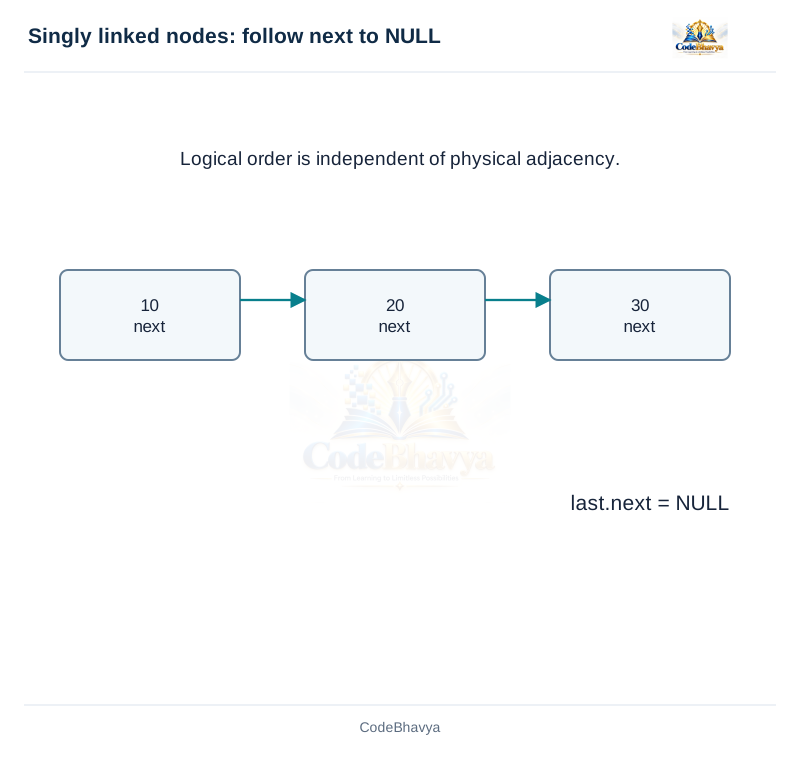
Two separate Node objects can hold 10 and 20. Set the first node’s next to the address of the second and set the second node’s next to NULL. Starting with the first node, following next reaches the second, then detects the null link at the end.
A node pointer does not create its target. Nodes may have automatic, static or allocated storage with different lifetimes. In a dynamic list, allocate each needed node, check the result and free it when removed. Never retain a link to an object whose lifetime has ended.
Reading the current node’s data or next member is O(1). Following links to visit n nodes takes O(n) time. A single next link does not provide constant-time indexed access to an arbitrary position. This type is the foundation for the singly linked-list operations in Unit III.