THE SYLLABUS QUESTION
What you need to solve
Write a C program that uses functions to perform: I. To insert a sub-string into a given main string from a given position. II. To delete n Characters from a given position in a given string.
Line 1: operation 1 (insert) or 2 (delete). Line 2: main string (at most 255 bytes). For insert: line 3 is the substring (at most 127 bytes), then position on line 4. For delete: line 3 contains position and count. Positions are 1-based; final string must fit 255 bytes.
UNDERSTAND THE IDEA
Explanation
Insertion makes room by shifting the suffix, including the null terminator, to the right. Copy the substring into the gap.
Deletion closes a gap by shifting the remaining suffix left, again including the null terminator. Separate functions perform each operation.
A user position of 1 means index 0. Insertion can use length + 1 to append. Deletion requires the complete requested range to exist; invalid ranges are rejected rather than silently shortened. Examples use ordinary ASCII text; these byte-based operations do not handle Unicode grapheme boundaries.
PLAN BEFORE CODING
Algorithm
- Read the operation and consume the rest of its line.
- Read the main string with a bounded helper.
- For insertion, read the substring and validate the position and capacity.
- For deletion, validate position and count.
- Call the matching function and display the resulting string.
SEE THE CONTROL FLOW
Flowchart
Follow the arrows from Start. Diamonds ask a question; labeled arrows show the answer. A returning arrow repeats a loop. Function internals are grouped where needed; later input checks follow the rules in the program.
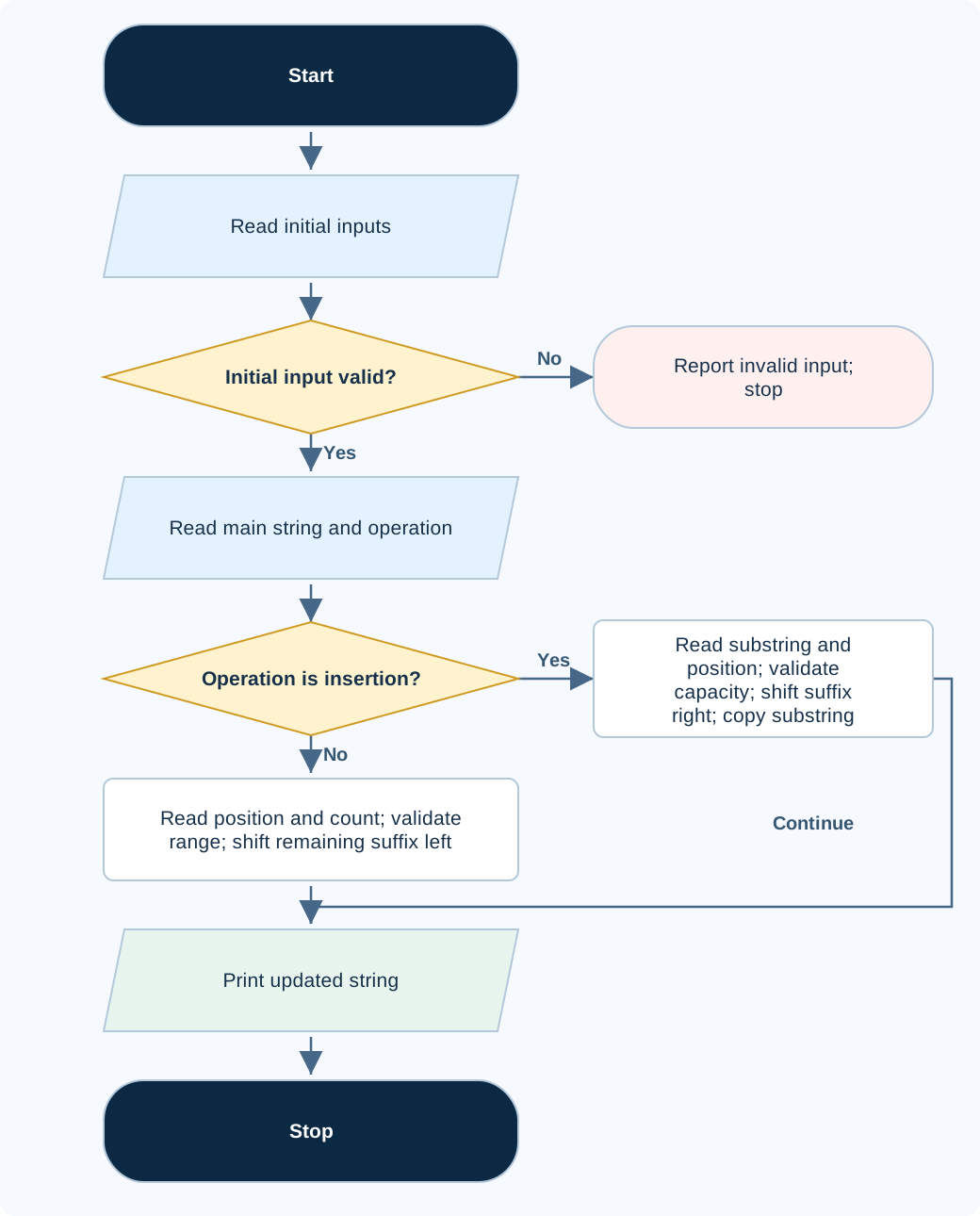
On a phone, scroll sideways to read the diagram at full size. Open full-size flowchart ↗
#include <stdio.h>
#include <string.h>

int readLine(char text[], size_t capacity) {
    if (fgets(text, (int)capacity, stdin) == NULL) return 0;
    size_t length = strlen(text);
    if (length > 0 && text[length - 1] == '\n') text[--length] = '\0';
    else if (!feof(stdin)) {
        int ch = getchar();
        if (ch != '\n' && ch != EOF) return 0;
    }
    if (length > 0 && text[length - 1] == '\r') text[length - 1] = '\0';
    return 1;
}

int insertSubstring(char mainText[], size_t capacity,
                    const char subText[], int position) {
    int length = (int)strlen(mainText);
    int subLength = (int)strlen(subText);
    if (position < 1 || position > length + 1 ||
        (size_t)(length + subLength) >= capacity) return 0;
    int index = position - 1;
    for (int i = length; i >= index; --i)
        mainText[i + subLength] = mainText[i];
    for (int i = 0; i < subLength; ++i) mainText[index + i] = subText[i];
    return 1;
}

int deleteCharacters(char text[], int position, int count) {
    int length = (int)strlen(text);
    if (position < 1 || position > length + 1 || count < 0 ||
        count > length - (position - 1)) return 0;
    int index = position - 1;
    for (int i = index; i <= length - count; ++i) text[i] = text[i + count];
    return 1;
}

int main(void) {
    char text[256], substring[128];
    int operation, position, count, ch;
    if (scanf("%d", &operation) != 1 || (operation != 1 && operation != 2)) {
        puts("Invalid input."); return 1;
    }
    while ((ch = getchar()) != '\n' && ch != EOF) { }
    if (!readLine(text, sizeof text)) { puts("Invalid input."); return 1; }
    if (operation == 1) {
        if (!readLine(substring, sizeof substring) || scanf("%d", &position) != 1 ||
            !insertSubstring(text, sizeof text, substring, position)) {
            puts("Invalid insertion."); return 1;
        }
    } else {
        if (scanf("%d %d", &position, &count) != 2 || !deleteCharacters(text, position, count)) {
            puts("Invalid deletion."); return 1;
        }
    }
    printf("Result: %s\n", text);
    return 0;
}
Code loads into the existing compiler. Enter the sample input there; sign-in and execution rules stay the same.
Compile and run locally
gcc -std=c17 substring-insert-delete.c -o lab
./lab
On Windows, run .\lab.exe after compiling with GCC. The interest program requires the math library where applicable.
FOLLOW THE VALUES
Dry run
| Step / state | Operation | Result |
|---|---|---|
| Main = HelloWorld; substring = space; position = 6 | Index = 5 | Shift World and null terminator right |
| Insert | Copy space at index 5 | Hello World |
| Delete 1 character at position 6 | Move World left | HelloWorld |
CHECK THE BEHAVIOR
Sample input & output
Each output below was produced by compiling and running this exact program. Input values are entered in the stated order; the examples do not print input prompts.
Sample 1
1
HelloWorld

6
Result: Hello World
Sample 2
2
Hello World
6 1
Result: HelloWorld
Sample 3
1
abc
XYZ
4
Result: abcXYZ
Common mistakes
- Shift from the end during insertion so original characters are not overwritten.
- Always move the null terminator and check the destination buffer capacity.
WHY THIS GROWTH RATE?
Time and space complexity
Insertion O(L + S); deletion O(L). Fixed string buffers; O(1) additional working space.
Let L be the original main-string length and S the substring length. Insertion obtains both lengths, shifts at most L + 1 bytes including the null terminator, and copies S substring bytes. These are consecutive operations, so their costs add to O(L + S).
Deletion obtains the string length and shifts the remaining suffix left, visiting at most L bytes. Even deleting zero characters still scans for the length in this implementation, so the deletion operation is O(L).
Insertion and deletion operate in the existing main-string buffer. The supplied buffers have fixed capacities; only counters are extra working storage, giving O(1) auxiliary space beyond those buffers. A generalized variable-capacity version would need O(L + S) input-buffer storage.
Big-O describes how work grows as the stated input quantity grows; fixed factors and lower-order terms are omitted. The analysis treats fixed-width arithmetic as constant cost and the published limits as practical safety bounds.