THE SYLLABUS QUESTION
What you need to solve
Write a C program to determine if the given string is a palindrome or not (spelled the same in both directions, with or without a meaning, like madam, civic, noon, abcba).
One non-empty line of at most 255 bytes. Comparison is exact and case-sensitive; spaces and punctuation are included. Use ASCII text for this byte-based example.
UNDERSTAND THE IDEA
Explanation
Compare matching characters from the two ends and move inward. A mismatch means the string is not a palindrome.
Only half the characters need comparison. This version keeps the original text unchanged and does not ignore letter case or spaces.
PLAN BEFORE CODING
Algorithm
- Read a bounded, non-empty string.
- Start left at 0 and right at the string length.
- Decrement right before comparing the two characters.
- Stop on mismatch or after reaching the middle.
- Print the result.
SEE THE CONTROL FLOW
Flowchart
Follow the arrows from Start. Diamonds ask a question; labeled arrows show the answer. A returning arrow repeats a loop. Function internals are grouped where needed; later input checks follow the rules in the program.
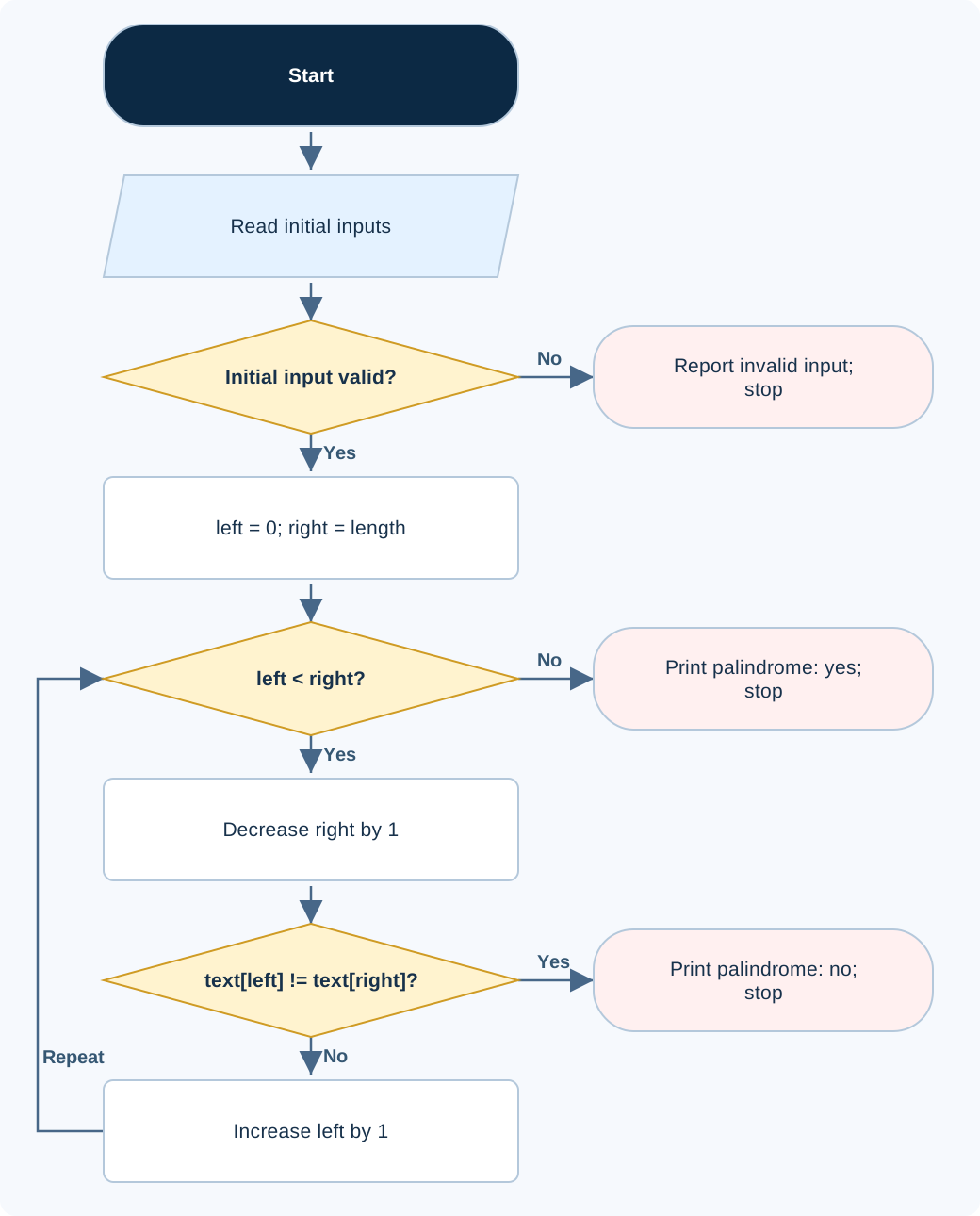
On a phone, scroll sideways to read the diagram at full size. Open full-size flowchart ↗
#include <stdio.h>
#include <string.h>

int readLine(char text[], size_t capacity) {
    if (fgets(text, (int)capacity, stdin) == NULL) return 0;
    size_t length = strlen(text);
    if (length > 0 && text[length - 1] == '\n') text[--length] = '\0';
    else if (!feof(stdin)) {
        int ch = getchar();
        if (ch != '\n' && ch != EOF) return 0;
    }
    if (length > 0 && text[length - 1] == '\r') text[length - 1] = '\0';
    return 1;
}

int main(void) {
    char text[256];
    if (!readLine(text, sizeof text) || text[0] == '\0') {
        puts("Invalid input."); return 1;
    }
    size_t left = 0, right = strlen(text);
    int palindrome = 1;
    while (left < right) {
        --right;
        if (text[left] != text[right]) { palindrome = 0; break; }
        ++left;
    }
    printf("Palindrome: %s\n", palindrome ? "yes" : "no");
    return 0;
}
Code loads into the existing compiler. Enter the sample input there; sign-in and execution rules stay the same.
Compile and run locally
gcc -std=c17 string-palindrome.c -o lab
./lab
On Windows, run .\lab.exe after compiling with GCC. The interest program requires the math library where applicable.
FOLLOW THE VALUES
Dry run
| Step / state | Operation | Result |
|---|---|---|
| Text = madam | Compare positions 1 and 5 | m = m |
| Move inward | Compare positions 2 and 4 | a = a |
| Middle reached | No mismatch | Palindrome |
CHECK THE BEHAVIOR
Sample input & output
Each output below was produced by compiling and running this exact program. Input values are entered in the stated order; the examples do not print input prompts.
Sample 1
madam
Palindrome: yes
Sample 2
hello
Palindrome: no
Sample 3
Madam
Palindrome: no
Common mistakes
- Strip the input newline before comparison.
- State whether comparison ignores spaces/case; this program does not.
WHY THIS GROWTH RATE?
Time and space complexity
Time O(L); O(L) input storage and O(1) additional working space.
Let L be the string length. Reading the string and finding its length take O(L). The two-pointer comparison examines at most floor(L / 2) pairs, doing constant work per pair.
O(L) + O(L / 2) simplifies to O(L) time. A mismatch may end the comparison early, but reading the complete input still costs O(L). The input string uses O(L) storage and only two indices and a flag are needed beyond it: O(1) auxiliary space.
Big-O describes how work grows as the stated input quantity grows; fixed factors and lower-order terms are omitted. The analysis treats fixed-width arithmetic as constant cost and the published limits as practical safety bounds.