THE SYLLABUS QUESTION
What you need to solve
Write a C program that sorts a given array of names.
Line 1: number of names (1–20). Next n lines: non-empty names, each at most 63 bytes. Spaces within names are allowed. Sorting is ascending, case-sensitive lexicographic order using strcmp; examples use ASCII.
UNDERSTAND THE IDEA
Explanation
Store names in a two-dimensional character array. Each row is one null-terminated string.
strcmp compares string contents. If the left name is greater, swap the entire strings using a temporary buffer and strcpy. This example uses bubble sort.
The order is byte-based and case-sensitive, rather than locale-aware dictionary order. Use a consistent letter case if that is the desired classroom ordering.
PLAN BEFORE CODING
Algorithm
- Read the count and consume the rest of its input line.
- Read each bounded name, preserving embedded spaces.
- Compare adjacent names with strcmp.
- Swap complete strings when they are out of order.
- Print the sorted names, one per line.
SEE THE CONTROL FLOW
Flowchart
Follow the arrows from Start. Diamonds ask a question; labeled arrows show the answer. A returning arrow repeats a loop. Function internals are grouped where needed; later input checks follow the rules in the program.
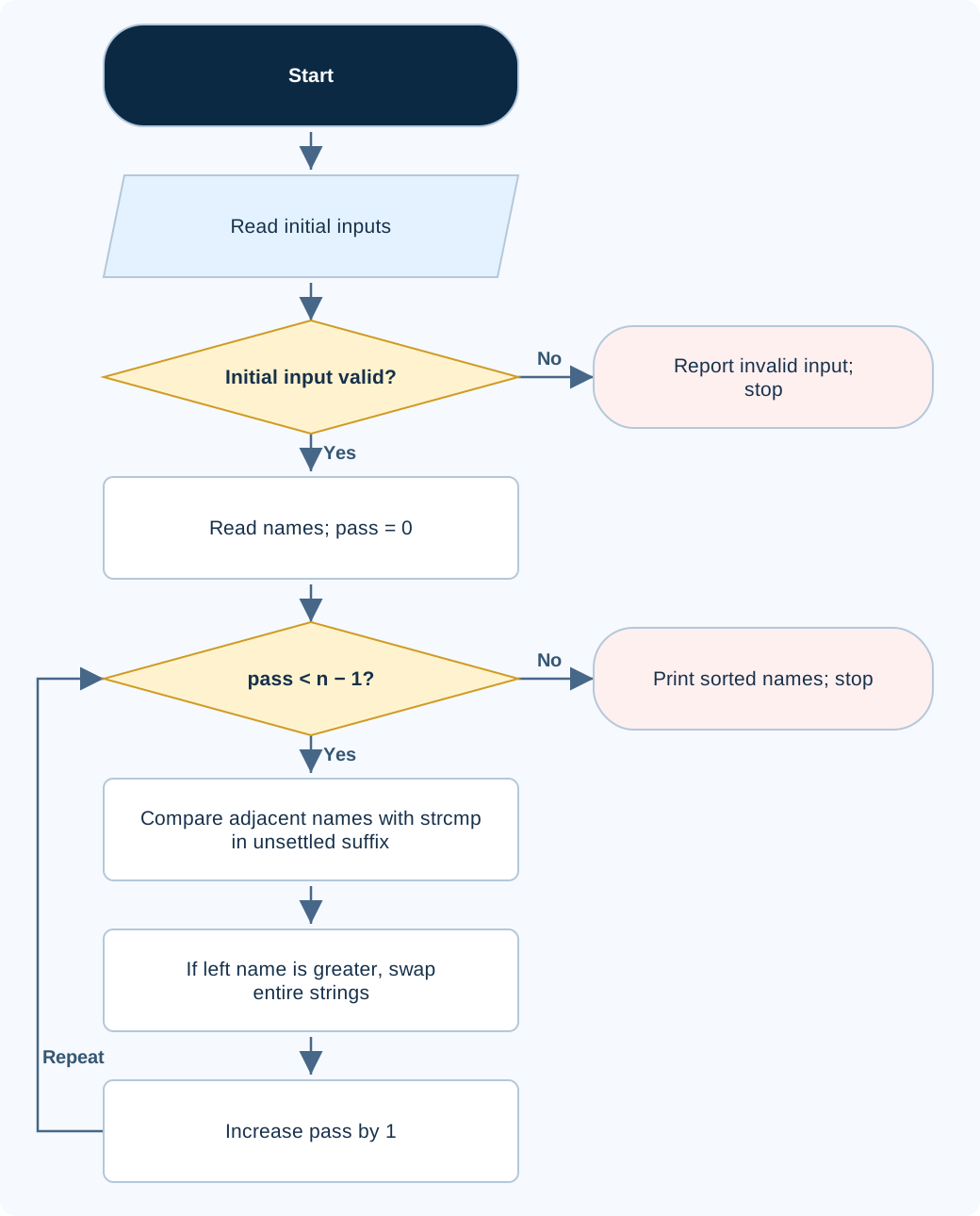
On a phone, scroll sideways to read the diagram at full size. Open full-size flowchart ↗
#include <stdio.h>
#include <string.h>
#define MAX_NAMES 20
#define NAME_SIZE 64

int readLine(char text[], size_t capacity) {
    if (fgets(text, (int)capacity, stdin) == NULL) return 0;
    size_t length = strlen(text);
    if (length > 0 && text[length - 1] == '\n') text[--length] = '\0';
    else if (!feof(stdin)) {
        int ch = getchar();
        if (ch != '\n' && ch != EOF) return 0;
    }
    if (length > 0 && text[length - 1] == '\r') text[length - 1] = '\0';
    return 1;
}

int main(void) {
    char names[MAX_NAMES][NAME_SIZE], temporary[NAME_SIZE];
    int n, ch;
    if (scanf("%d", &n) != 1 || n < 1 || n > MAX_NAMES) {
        puts("Invalid input."); return 1;
    }
    while ((ch = getchar()) != '\n' && ch != EOF) { }
    for (int i = 0; i < n; ++i) {
        if (!readLine(names[i], sizeof names[i]) || names[i][0] == '\0') {
            puts("Invalid input."); return 1;
        }
    }
    for (int pass = 0; pass < n - 1; ++pass)
        for (int j = 0; j < n - 1 - pass; ++j)
            if (strcmp(names[j], names[j + 1]) > 0) {
                strcpy(temporary, names[j]);
                strcpy(names[j], names[j + 1]);
                strcpy(names[j + 1], temporary);
            }
    puts("Sorted names:");
    for (int i = 0; i < n; ++i) puts(names[i]);
    return 0;
}
Code loads into the existing compiler. Enter the sample input there; sign-in and execution rules stay the same.
Compile and run locally
gcc -std=c17 sort-names.c -o lab
./lab
On Windows, run .\lab.exe after compiling with GCC. The interest program requires the math library where applicable.
FOLLOW THE VALUES
Dry run
| Step / state | Operation | Result |
|---|---|---|
| Names: Venu, Anu, Bhavya | Compare Venu and Anu | Swap |
| Compare Venu and Bhavya | Swap | Anu, Bhavya, Venu |
| Next pass | Anu precedes Bhavya | Sorted |
CHECK THE BEHAVIOR
Sample input & output
Each output below was produced by compiling and running this exact program. Input values are entered in the stated order; the examples do not print input prompts.
Sample 1
3
Venu
Anu
Bhavya
Sorted names:
Anu
Bhavya
Venu
Sample 2
3
Mary Jane
Anu
Zoya
Sorted names:
Anu
Mary Jane
Zoya
Sample 3
1
Ravi
Sorted names:
Ravi
Common mistakes
- Use strcmp instead of comparing string pointers with >.
- Use a temporary string buffer large enough for the whole name.
WHY THIS GROWTH RATE?
Time and space complexity
Time O(n² × L), where L is the maximum name length; O(L) additional swap storage.
Let n be the number of names and L the maximum name length. The nested bubble-sort loops make n(n − 1)/2 comparisons. strcmp may examine up to L characters per comparison, and each swap copies strings with O(L) work.
Combining O(n²) pair operations with O(L) string work gives O(n² × L) worst-case time. This version has no early-stop flag, so even sorted names still undergo all pair comparisons; comparisons may be faster when names differ near the beginning.
The names array uses O(n × L) input storage. The temporary name buffer used for a swap requires O(L) extra storage. Here the buffers are capped at 20 names of 63 characters, but the formula explains how the algorithm scales with these quantities.
Big-O describes how work grows as the stated input quantity grows; fixed factors and lower-order terms are omitted. The analysis treats fixed-width arithmetic as constant cost and the published limits as practical safety bounds.