THE SYLLABUS QUESTION
What you need to solve
Write a C program to find the sum of individual digits of a positive integer and test given number is palindrome.
One non-negative integer up to 999,999,999,999,999,999. The program also handles 0; leading zeros are not part of an integer value.
UNDERSTAND THE IDEA
Explanation
The remainder n % 10 extracts the last decimal digit. Dividing by 10 removes that digit.
Accumulate the digit sum and build the reversed number with reverse = reverse × 10 + digit. Preserve the original number before modifying the working copy. The 18-digit limit keeps the reversal within long long.
PLAN BEFORE CODING
Algorithm
- Save the original input and initialize sum and reverse to zero.
- Extract one digit with % 10.
- Add it to the sum and append it to the reverse.
- Remove the digit with integer division by 10.
- Compare the reverse with the original number.
SEE THE CONTROL FLOW
Flowchart
Follow the arrows from Start. Diamonds ask a question; labeled arrows show the answer. A returning arrow repeats a loop. Function internals are grouped where needed; later input checks follow the rules in the program.
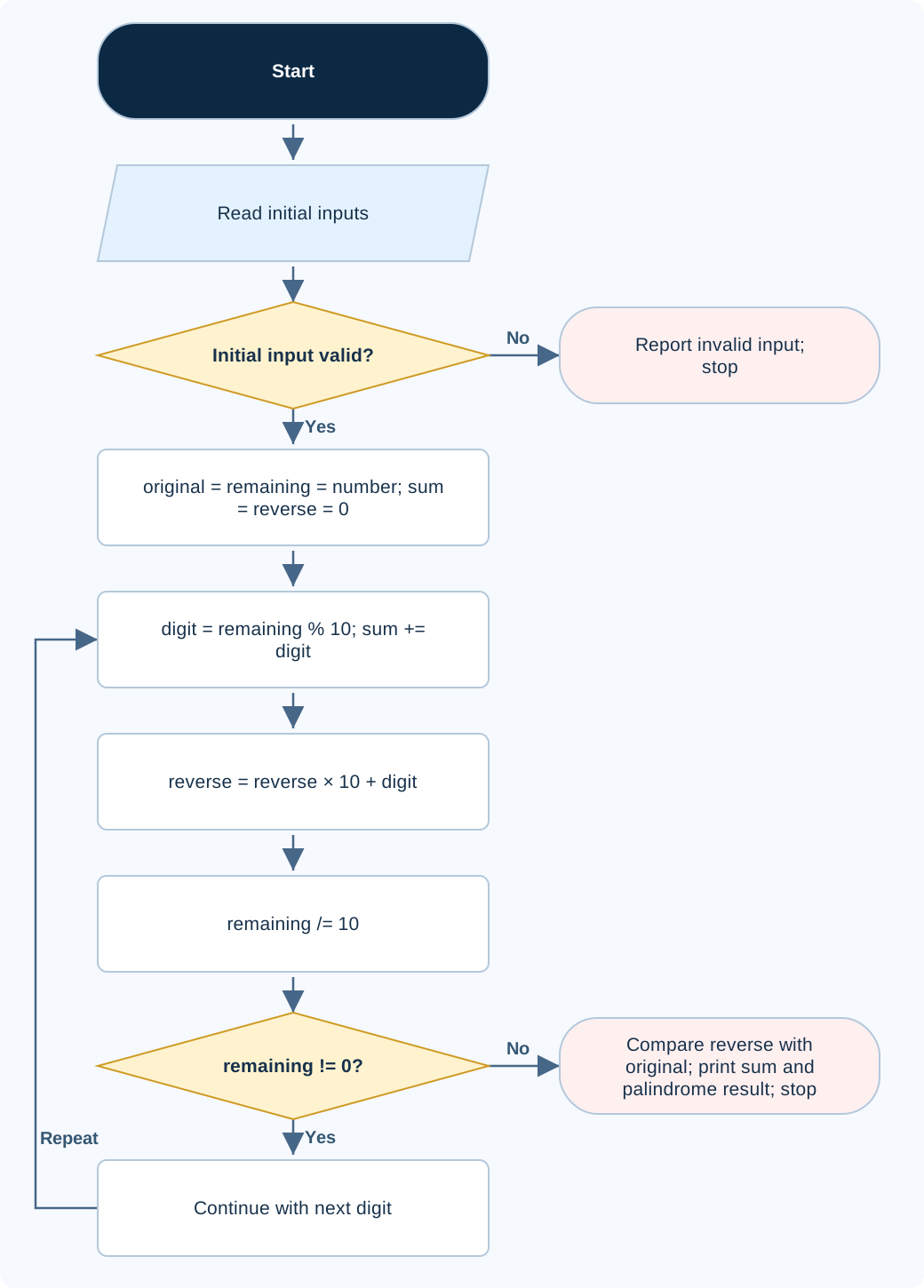
On a phone, scroll sideways to read the diagram at full size. Open full-size flowchart ↗
#include <stdio.h>

int main(void) {
    long long number, remaining, reverse = 0;
    int sum = 0;
    if (scanf("%lld", &number) != 1 || number < 0 || number > 999999999999999999LL) {
        puts("Invalid input.");
        return 1;
    }
    remaining = number;
    do {
        int digit = (int)(remaining % 10);
        sum += digit;
        reverse = reverse * 10 + digit;
        remaining /= 10;
    } while (remaining != 0);
    printf("Digit sum: %d\n", sum);
    printf("Palindrome: %s\n", reverse == number ? "yes" : "no");
    return 0;
}
Code loads into the existing compiler. Enter the sample input there; sign-in and execution rules stay the same.
Compile and run locally
gcc -std=c17 digit-sum-palindrome.c -o lab
./lab
On Windows, run .\lab.exe after compiling with GCC. The interest program requires the math library where applicable.
FOLLOW THE VALUES
Dry run
| Step / state | Operation | Result |
|---|---|---|
| Working value 121 | digit = 1 | sum = 1; reverse = 1 |
| Working value 12 | digit = 2 | sum = 3; reverse = 12 |
| Working value 1 | digit = 1 | sum = 4; reverse = 121 |
CHECK THE BEHAVIOR
Sample input & output
Each output below was produced by compiling and running this exact program. Input values are entered in the stated order; the examples do not print input prompts.
Sample 1
121
Digit sum: 4
Palindrome: yes
Sample 2
1234
Digit sum: 10
Palindrome: no
Sample 3
0
Digit sum: 0
Palindrome: yes
Common mistakes
- Do not compare with the working value after it has become zero.
- An unrestricted reversal can overflow the selected integer type.
WHY THIS GROWTH RATE?
Time and space complexity
Time O(digits); auxiliary space O(1).
Let d be the number of decimal digits. Every iteration extracts one digit with % 10, adds it to the sum, appends it to the reverse and removes it using / 10. Exactly d iterations are needed, including one iteration for zero.
A constant amount of work per digit gives O(d) time. For a positive value N, d = floor(log10 N) + 1, so the time can also be written O(log N). The reverse is stored as a number rather than an extra digit array, giving O(1) auxiliary space within the stated input limit.
Big-O describes how work grows as the stated input quantity grows; fixed factors and lower-order terms are omitted. The analysis treats fixed-width arithmetic as constant cost and the published limits as practical safety bounds.