THE SYLLABUS QUESTION
What you need to solve
Write a C program that implements the Bubble sort method to sort a given list of integers in ascending order.
Array size n (1–100), followed by n integers between -1,000,000 and 1,000,000.
UNDERSTAND THE IDEA
Explanation
Compare neighboring elements and swap them when the left value is greater. After each pass, the largest remaining value has moved to the end.
The already-settled suffix does not need another comparison. A swapped flag stops early when a pass makes no changes.
PLAN BEFORE CODING
Algorithm
- Read the array.
- Compare adjacent elements in the unsettled portion.
- Swap pairs that are out of ascending order.
- Stop early if no swap occurs in a pass.
- Print the sorted array.
SEE THE CONTROL FLOW
Flowchart
Follow the arrows from Start. Diamonds ask a question; labeled arrows show the answer. A returning arrow repeats a loop. Function internals are grouped where needed; later input checks follow the rules in the program.
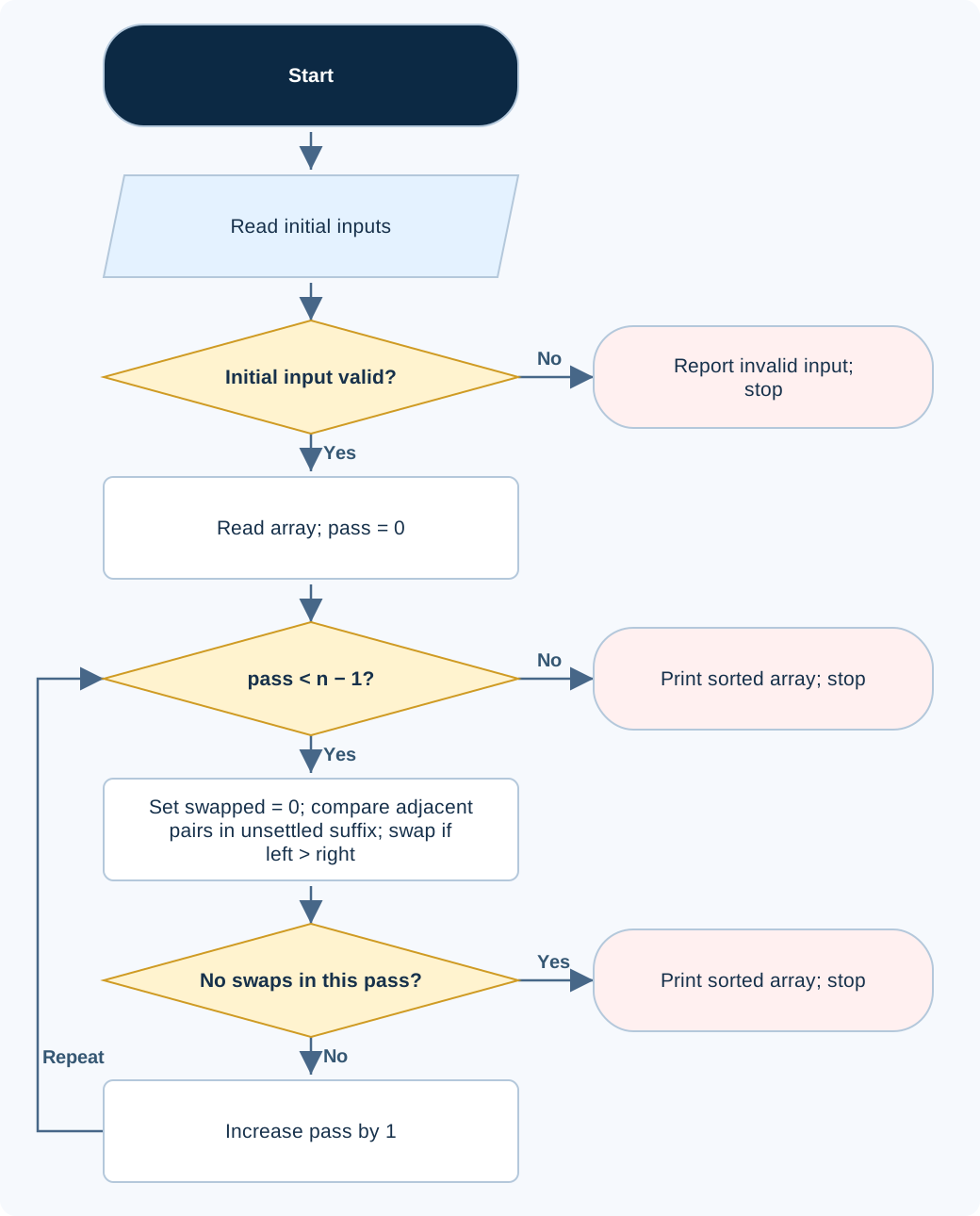
On a phone, scroll sideways to read the diagram at full size. Open full-size flowchart ↗
#include <stdio.h>
#define MAX_SIZE 100

int readArray(int a[], int *n) {
    if (scanf("%d", n) != 1 || *n < 1 || *n > MAX_SIZE) return 0;
    for (int i = 0; i < *n; ++i)
        if (scanf("%d", &a[i]) != 1 || a[i] < -1000000 || a[i] > 1000000) return 0;
    return 1;
}

void printArray(const int a[], int n) {
    for (int i = 0; i < n; ++i) printf("%s%d", i == 0 ? "" : " ", a[i]);
    putchar('\n');
}

void bubbleSort(int a[], int n) {
    for (int pass = 0; pass < n - 1; ++pass) {
        int swapped = 0;
        for (int j = 0; j < n - 1 - pass; ++j) {
            if (a[j] > a[j + 1]) {
                int temp = a[j]; a[j] = a[j + 1]; a[j + 1] = temp;
                swapped = 1;
            }
        }
        if (!swapped) break;
    }
}

int main(void) {
    int a[MAX_SIZE], n;
    if (!readArray(a, &n)) { puts("Invalid input."); return 1; }
    bubbleSort(a, n);
    printf("Ascending: "); printArray(a, n);
    return 0;
}
Code loads into the existing compiler. Enter the sample input there; sign-in and execution rules stay the same.
Compile and run locally
gcc -std=c17 bubble-sort-ascending.c -o lab
./lab
On Windows, run .\lab.exe after compiling with GCC. The interest program requires the math library where applicable.
FOLLOW THE VALUES
Dry run
| Step / state | Operation | Result |
|---|---|---|
| Start | 5 1 4 2 | Unsorted |
| Pass 1 | 1 4 2 5 | 5 settles at the end |
| Pass 2 | 1 2 4 5 | 4 settles |
| Pass 3 | No swaps | Stop |
CHECK THE BEHAVIOR
Sample input & output
Each output below was produced by compiling and running this exact program. Input values are entered in the stated order; the examples do not print input prompts.
Sample 1
4
5 1 4 2
Ascending: 1 2 4 5
Sample 2
5
3 -1 3 0 -2
Ascending: -2 -1 0 3 3
Sample 3
1
7
Ascending: 7
Common mistakes
- The condition j < n - 1 - pass prevents reading beyond a[j + 1].
- Reset swapped at the beginning of each pass.
WHY THIS GROWTH RATE?
Time and space complexity
Time O(n²) worst case and O(n) best case with early stopping; O(1) additional space.
In the worst case, passes compare (n − 1), (n − 2), …, 1 adjacent pairs. Their sum is n(n − 1)/2, whose largest term grows as n². Swapping each pair has constant cost, so worst-case time is O(n²).
This implementation records whether a pass made a swap. An already sorted array needs one pass of n − 1 comparisons, then stops: O(n) best-case time. It sorts in the original array and uses one temporary value plus counters, giving O(1) auxiliary space.
Big-O describes how work grows as the stated input quantity grows; fixed factors and lower-order terms are omitted. The analysis treats fixed-width arithmetic as constant cost and the published limits as practical safety bounds.